Classical Christian Psychologist Paul Tournier on Old Age, Death, and Faith
Aging

Classical Christian Psychologist Paul Tournier on Old Age, Death, and Faith

Tournier reminds us that we may experience many successes, but as we grow older, “success retreats, and escapes us, it is limited, unfulfilled.” “When one comes to the end, a man’s life is nothing much.” “Professional life is over, and it finishes unfinished. This is a prefiguration of death, in which the whole of life will finish it, too, being unfinished. That is the dramatic contradiction of death.” Quoting Robert Mehl: “An end, but not a fulfilment, that is the face of death.” […]
Summary of Papacies Between Trent and Vatican II. How Did These Popes Prepare the Way for Vatican II?
History

Summary of Papacies Between Trent and Vatican II. How Did These Popes Prepare the Way for Vatican II?

How did the Catholic Church survive the French Revolution, the conquests of Napoleon, and the Revolutions of 1848? Was the Second Vatican Council a continuation of Vatican I? Was Pope Leo XIII, who issued Rerum Novarum, the social justice encyclical that sympathized with the working man, a conservative or a […]

Pope Benedict XV and Pope Pius XI: Confronting World War I and World War II, and Fascism
History

Pope Benedict XV and Pope Pius XI: Confronting World War I and World War II, and Fascism

Mussolini signaled in a speech that he was open to negotiating the Roman question. Mussolini was not a practicing Catholic and was famously a serial philanderer. Like Napoleon before him, Mussolini realized that it was in his political interest to settle this issue and regularize the status of the Vatican City.
O’Malley writes: “The most momentous aspect of the Lateran Agreements was the establishment of the Vatican City as a fully independent and sovereign state, with its own postal service, police force, full diplomatic corps, and so forth. The Italian state agreed never to interfere in the free functioning of Vatican City and ensured full and safe access to it by anyone the papacy wanted to receive. The papacy agreed never to try directly or indirectly to reestablish the Papal States, and it relinquished in perpetuity all claim to the city of Rome.”
The Vatican was paid a generous indemnity for the loss of this territory, and the state would pay an annual stipend for the upkeep of historical monuments. In addition to the 103 acres in Vatican City, the pope could also use several churches and castles traditionally at the church’s disposal. […]

The Boy in the Striped Pajamas- Does This Children’s Book Whitewash the Horrors of the Holocaust
AntiSemitism

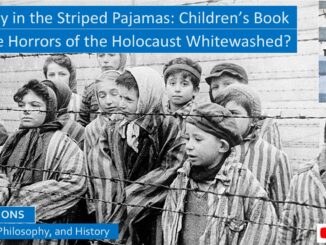
The Boy in the Striped Pajamas: Does This Children’s Book Whitewash the Horrors of the Holocaust?

My deeper objection to this book is the thought that the young son of the commandant could be so naïve that he would not realize that making a friend of a Jewish boy would be seen as repugnant. The reality was that anti-Semitism was a core belief of the Nazi state, and this was an important virtue that the Nazi engrained in the lessons taught to impressionable youngsters both in the Nazi Youth clubs and in the public school system. Furthermore, children were taught that the Nazi virtues prohibited them from associating with Jews. […]

Norman Rockwell, Life and Paintings
Current Events and History

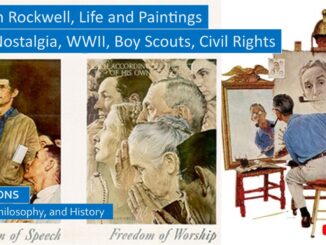
Norman Rockwell, Life and Paintings

Was Norman Rockwell a serious artist, or was he an illustrator? Early in his career other artists derided him as an illustrator, which did not offend him in the least, as he considered himself an illustrator. Unlike a true artist, he had no need for patrons. In his 1960 Triple Self Portrait, we see Normal Rockwell painting himself, with self-portraits by famous painters pinned to his easel, including Rembrandt, Vincent van Gogh, and Picasso.
[…]

Summary of Mere Christianity, WWII Ecumenical Broadcast: Morality, Not Polemics
CS Lewis

Summary of CS Lewis’ Mere Christianity, WWII Ecumenical Broadcast: Morality Not Polemics

Many scholars speculate on whether CS Lewis was inspired by the writings of Richard Baxter, a Puritan and prolific author who first coined the phrase “Mere Christianity.” Baxter lived during the intense religious struggle in the late 1600’s, a century after Henry VIII split from the Catholic Church to form the Anglican Church. Baxter was appointed to the royal chaplaincy, but he left his post after the passage of the Act of Uniformity in 1662, which required that all pastors exclusively use the Book of Common Prayer and be ordained as Anglican ministers. Baxter was reluctant to adopt a denomination, proclaiming that “I am a Christian, a MEER CHRISTIAN, of no other religion,” and “I am against all sects and dividing parties.” He did not want to identify either with Catholics, or Anglicans, or Presbyterians. […]

CS Lewis’ Mere Christianity: Forgiveness, Pride, and Envy. Can Pride Ever Be Good?
CS Lewis

CS Lewis’ Mere Christianity: Forgiveness, Pride, and Envy. Can Pride Ever Be Good?

CS Lewis notes that in the middle of the Lord’s Prayer we pray: “Forgive us our sins as we forgive those who sin against us.” He observes: “There is no slightest suggestion that we are offered forgiveness on any other terms. It is made perfectly clear that if we do not forgive, we shall not be forgiven.”
Indeed, immediately after the Lord’s Prayer in Matthew, Jesus exhorts us: “For if you forgive men their trespasses, your heavenly Father also will forgive you; but if you do not forgive men their trespasses, neither will your Father forgive your trespasses.” […]

CS Lewis’ Mere Christianity: Reflections on Intimacy, Romance, Marriage, and Divorce
CS Lewis

CS Lewis’ Mere Christianity: Intimacy, Romance, Marriage, and Divorce

CS Lewis continues: “Being in love is a good thing, but it is not the best thing.” “You cannot make it the basis of a whole life. It is a noble feeling, but it is still a feeling.” But CS Lewis warns us that the initial excitement will not last, that “love in the second sense is not merely a feeling, but is a deep unity, maintained by the will and deliberately strengthened by habit, reinforced in Christian marriages by the grace which both partners ask, and receive, from God.” […]

Faith, Hope, Charity, and Love in CS Lewis’ Mere Christianity: The Theological Virtues
CS Lewis

Faith, Hope, Charity, and Love in CS Lewis’ Mere Christianity: The Theological Virtues

CS Lewis teaches us, “Charity means Love in the Christian sense. But love, in the Christian sense, does not mean an emotion. It is a state not of the feelings but of the will; that state of the will which we have naturally about ourselves and must learn to have about other people.”
“Do not waste time bothering whether you ‘love’ your neighbor; act as if you did.” Be kind to your neighbor, and often you will like and love him more. But if they do not reciprocate, or are openly hostile, love them anyway, and help them if you can. We always find it easier to love, or like, those who are courteous towards us. […]