Summary of Papacies Between Trent and Vatican II. How Did These Popes Prepare the Way for Vatican II?
History

Summary of Papacies Between Trent and Vatican II. How Did These Popes Prepare the Way for Vatican II?

How did the Catholic Church survive the French Revolution, the conquests of Napoleon, and the Revolutions of 1848? Was the Second Vatican Council a continuation of Vatican I? Was Pope Leo XIII, who issued Rerum Novarum, the social justice encyclical that sympathized with the working man, a conservative or a […]

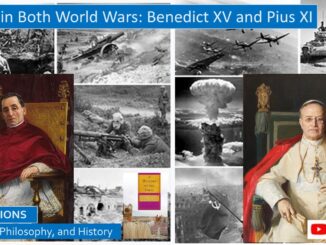
Pope Benedict XV and Pope Pius XI: Confronting World War I and World War II, and Fascism
History

Pope Benedict XV and Pope Pius XI: Confronting World War I and World War II, and Fascism

Mussolini signaled in a speech that he was open to negotiating the Roman question. Mussolini was not a practicing Catholic and was famously a serial philanderer. Like Napoleon before him, Mussolini realized that it was in his political interest to settle this issue and regularize the status of the Vatican City.
O’Malley writes: “The most momentous aspect of the Lateran Agreements was the establishment of the Vatican City as a fully independent and sovereign state, with its own postal service, police force, full diplomatic corps, and so forth. The Italian state agreed never to interfere in the free functioning of Vatican City and ensured full and safe access to it by anyone the papacy wanted to receive. The papacy agreed never to try directly or indirectly to reestablish the Papal States, and it relinquished in perpetuity all claim to the city of Rome.”
The Vatican was paid a generous indemnity for the loss of this territory, and the state would pay an annual stipend for the upkeep of historical monuments. In addition to the 103 acres in Vatican City, the pope could also use several churches and castles traditionally at the church’s disposal. […]
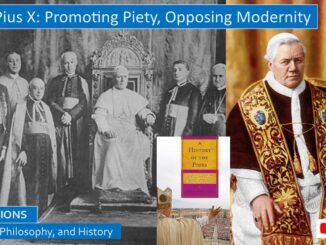
Pope Pius X, Promoting Piety, Rejecting Modernism
History

Pope Pius X, Promoting Piety, Rejecting Modernism

After the long and momentous papacy of Pope Leo XIII, the cardinals sought a candidate who would be a pastoral pope. They chose Guiseppe Sarto, who had spent his entire priestly life as a pastor, last serving as patriarch of Venice. He was from a family of modest means, and for nine years he served as a priest in a country parish. His formal education was meager, he studied at a seminary in Padua.
Our author John O’Malley explains: “Pope Pius X had never set foot outside Italy. He saw things in terms of black and white. While still Patriarch of Venice, he wrote to a friend: ‘When we speak of the Vicar of Christ, we must not quibble. We must obey. We must not evaluate his judgments or criticize his directions lest we do injury to Jesus Christ himself. Society is sick. The one hope, the one remedy, is the pope.’ The words ring like an Ultramontanist manifesto.” […]

Pope Leo XIV, First American Pope, Successor to Pope Francis and Social Justice of Pop Leo XIII
Modern Catholic Popes

Pope Leo XIV, First American Pope, Successor to Pope Francis and Social Justice of Pope Leo XIII

Pope Leo XIV notes: “What is striking about these two attitudes is their relevance today. They embody notions that we could easily find on the lips of many men and women in our own time, even if, while essentially identical, they are expressed in different language.”
“Even today, there are many settings in which the Christian faith is considered absurd, meant for the weak and unintelligent. Settings where other securities are preferred, like technology, money, success, power, or pleasure.” […]

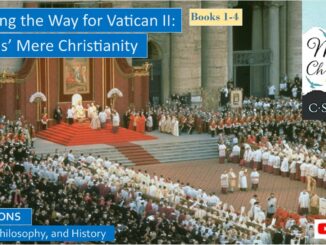
Preparing the Way for Vatican II: CS Lewis' Mere Christianity
CS Lewis

Preparing the Way for Vatican II: CS Lewis’ Mere Christianity

CS Lewis did not wave the flag of ecumenicism, attending this conference or that on interfaith dialogues, but instead prepares the way, saying that what denominational creed you profess is less important than whether you truly believe the core Christian teaching of the two-fold Love of God and neighbor. This was the key change wrought by Vatican II, no longer did the Catholic Church believe you needed to be Catholic to be saved. Likewise, CS Lewis is against the notion that Catholics cannot be saved. […]

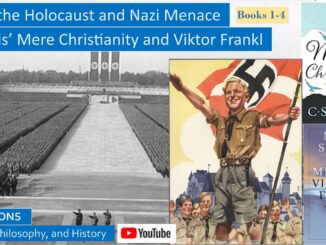
Facing the Nazi Menace: CS Lewis' Mere Christianity and Viktor Frankl's Man's Search for Meaning
CS Lewis

Facing the Nazi Menace: CS Lewis’ Mere Christianity and Viktor Frankl’s Man’s Search for Meaning

Mere Christianity was compiled from a series of radio addresses by CS Lewis explaining the tenets of Christianity which were broadcast during the dark days of World War II, when Londoners fled to the safety of the underground subway tunnels while Nazi bombers destroyed their homes above. We will reflect on the many instances where CS Lewis referred often to this monumental struggle, one of the rare political struggles that actually pitted the forces of good and evil against each other, in Mere Christianity. […]

Martin Luther King, I Have a Dream Speech, March on Washington DC, Biography
Civil Rights

Martin Luther King, I Have a Dream Speech, March on Washington DC, Biography Chapter 8

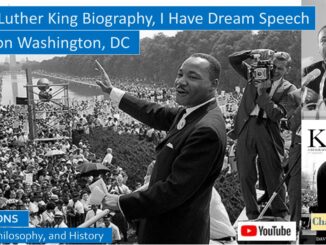
MLK’s I Have a Dream Speech begins: “Five score years ago, a great American, in whose symbolic shadow we stand today, signed the Emancipation Proclamation. This momentous decree came as a great beacon light of hope to millions of Negro slaves who had been seared in the flames of withering injustice. It came as a joyous daybreak to end the long night of their captivity.” […]

Q & A on Topic: Why Did You Leave Your Religion?
Biblical Interpretation

Q & A on Topic: Why Did You Leave Your Religion?

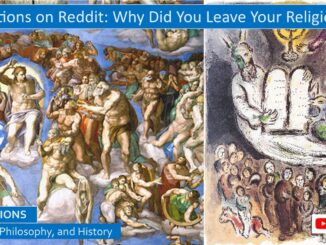
To the ancients who lived in a warrior culture, Stoic philosophy is very appealing. The Stoics don’t ask the question: Why do bad things happen to good people? Instead, they admit that good and bad things happen to everyone, that the rain falls on both the bad and the good. Bad things happen to good people, that is part of life. The real question is: How can God help us endure and prevail over our suffering? […]

Decalogue: Do Not Slander, Catholic Catechism 2465-2503, and St Thomas Aquinas
Command 8 Do Not Bear False Witness

Decalogue: Do Not Slander, Catholic Catechism and St Thomas Aquinas CCC 2465-2503

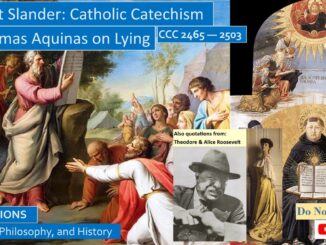
The Eight Commandment in the Catholic Catechism exhorts, “You shall not bear false witness against your neighbor.” Many people shorten this commandment to, You shall not lie, and although lying is usually sinful, this is a shallow understanding of this commandment. The positive form of the commandment is we should guard the reputation of our neighbor, it is possible to slander someone while speaking the truth about them. Gossip can be harmful whether it is truthful or not. […]

Modern Catholic Popes

Ratzinger Report, by Future Pope Benedict XVI, Preparing for Catholic Catechism

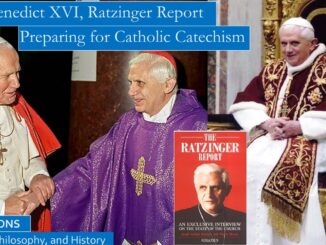
Cardinal Ratzinger teaches us: “Every council that bears fruit must be followed by a wave of holiness. Thus it was after Trent, and it achieved its aim of real reform for this reason. Salvation for the Church comes from within her,” not solely “from the decrees of the hierarchy. Whether Vatican II and its results will be considered as a luminous period of Church history will depend upon all the Catholics who are called to give it life. As Pope John Paul II said in his commemoration of Charles Borromeo in Milan, ‘the Church of today does not need any new reformers, the Church needs new saints.’” […]