Protestantism, Catholicism, Orthodoxy, and Judaism: Which Is True
christianity

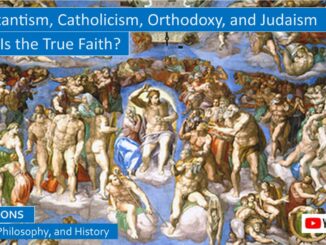
Protestantism, Catholicism, Orthodoxy, and Judaism: Which Is True?

We agree with CS Lewis when, in his Preface to Mere Christianity, he states that “the reader should be warned that I offer no help to anyone who is hesitating between two Christian denominations. You will not learn from me whether you ought to become an Anglican, a Methodist, a Presbyterian, or a Roman Catholic.” CS Lewis compares his Mere Christianity to a central hall opening up to many rooms, representative of the various denominations, saying that this hall is a place to wait while you try the different doors.
CS Lewis continues: “There is no mystery of my own position. I am a very ordinary layman of the Church of England, not especially high, nor especially low, nor especially anything else.” […]
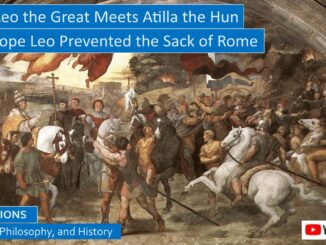
Pope Leo the Great, Confronting Attila the Hun, and His Role in Fourth Ecumenical Council of Chalcedon
Catholic Middle Ages and Beyond

Pope Leo the Great, Confronting Attila the Hun, and His Role in the Fourth Ecumenical Council of Chalcedon

As Pope Benedict XVI writes: “The times in which Pope Leo lived were very difficult: constant barbarian invasions, the gradual weakening of imperial authority in the West, and the long, drawn-out social crisis forced the Bishop of Rome” “to play an important role in both civil and political events.”
“In a period of profound crisis, Leo the Great knew how to make himself close to the people and the faithful with his pastoral action and his preaching. He enlivened charity in a Rome tried by famines, an influx of refugees, injustice, and poverty. He opposed pagan superstitions and actions of Manichaean groups. He associated the liturgy with the daily life of Christians.” […]

The Cruel Roman Emperor Commodus, Son of the Good Stoic Emperor Marcus Aurelius
Greek and Roman History

The Cruel Roman Emperor Commodus, Son of the Good Stoic Emperor Marcus Aurelius

The wise stoic reign of Marcus Aurelius, beloved by all, was followed by the murderous reign of Commodus, hated and feared by all, who would be assassinated by his closest companions. The disastrously reckless cruelty of Commodus, and his neglectful reign, which nearly caused the disintegration of the Roman Empire, colors the opinion of both ancient and modern historians. What historians mention, but do not emphasize, are the similarities between the soldier Hadrian and Commodus. Both liked to fight in the ring as gladiators. Both decided to halt the Roman policy of expansion, seeking strategic withdrawal. And Marcus Aurelius was as wary of his adoptive grandfather Hadrian as he was of his wayward son Commodus. […]

Were the Christians Actively Persecuted by Marcus Aurelius, Stoic Philosopher and Good Roman Emperor?
Greek and Roman History

Were the Christians Actively Persecuted by Marcus Aurelius, Stoic Philosopher and Good Roman Emperor?

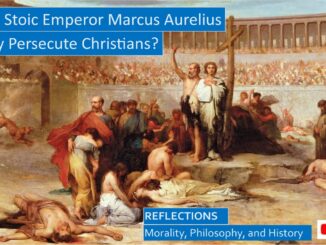
Today we will reflect on this question: Did the good Roman Emperor and Stoic Philosopher Marcus Aurelius actively persecute Christians? Why wasn’t Marcus Aurelius and other stoics impressed by the martyrdom of Christians in the arena? How could Marcus Aurelius espouse Christian values in his Stoic Meditations, while also including […]

History of Christian Persecutions, New Testament Through Marcus Aurelius
Greek and Roman History

History of Christian Persecutions, New Testament Through Marcus Aurelius

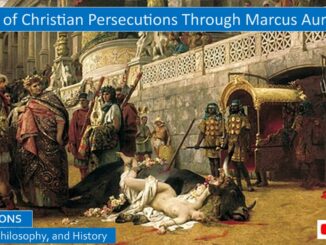
How widespread was the Christian persecution under the Roman Empire? Usually, it was a local affair, not until the reign of Diocletian was an empire-wide systematic persecution of Christians undertaken. The persecution under Nero was limited to Rome itself. The extent of the local persecution depended on the enthusiasm or cruelty of the local officials, many local officials had no enthusiasm for persecuting the local Christians, turning a blind eye. Overall, the number of persecutions was not huge, rarely were the Christian persecutions systematic, targeting all Christians. Indeed, the Christian martyrs in the twentieth century alone, mostly in Russia, dwarfed the number of Christian martyrs from the preceding nineteen centuries combined. […]