Epictetus, Eminent Roman Stoic Philosopher, on Living Well, Dying Well, and Opposing Suicide
Aging

Epictetus, Eminent Roman Stoic Philosopher, on Living Well, Dying Well, and Opposing Suicide

Is it wise to complain? Epictetus observes: “If someone dies young, he blames the gods because he is being taken before his time. If someone lingers on into extreme old age, he too blames the gods.” “Despite this, at the approach of death, he wants to stay alive; he sends for the doctors and begs him to do all he can.” “It is quite remarkable to see how people want neither to live nor to die.”
“Is health good and illness bad? No, man. What, then? Health managed well is good, but when badly managed, it is bad.”
Epictetus points out: “If you look at yourself in isolation, it is natural for you to live to an old age, to be rich, to be healthy. But if you look at yourself as a human being and as part of some whole, for the sake of that whole, it may be appropriate for you to be ill, or risk your life at sea, or be poor, or die young. Why get angry then?” “What is a human being? A part of a city made up of gods and human beings,” “a small copy of the universal city.” […]
Paul Tournier on Aging and Retirement
Aging

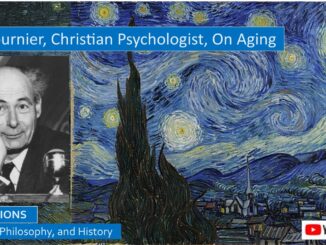
Classical Christian Psychologist Paul Tournier on Old Age and Retirement

Paul Tournier notes: “Freud defined psychological health under the double heading of aptitude for love and for work.” But Paul Tournier cautions that “the superficial relationships of working life and of sexual attraction must lead to a deeper personal commitment. And I believe that no commitment can be truly personal unless it takes on a transcendent dimension and become love, in the biblical meaning of the word.”
Paul Tournier is grateful: “As an intellectual, I am specially privileged. It is true that the better educated people are, the more chance they have to enjoy their retirement. First, intellectual work” is not physically taxing. “Second, the capacity for intellectual work is retained longer than physical ability. It can even increase in old age as long as disease does not affect the mental faculties. But most of all, the more one exercises one’s mind, the more pleasure it gives to exercise it. The more one learns, the more one wants to learn, and the easier study becomes.” […]

Modern Stoic Philosophers: My Favorite Maxims: Viktor Frankl, Nelson Mandela, and Others
Philosophy

Modern Stoic Philosophers: My Favorite Maxims: Viktor Frankl, Nelson Mandela, and Others

Why don’t the Roman Stoics discuss justice as much as Plato? In the direct Radical Democracy of Athens, the citizens served on the juries and passed the laws, which meant that ordinary citizens participated in rendering justice. This is why Socrates sought to educate ordinary citizens on justice. But in the Roman Empire, the totalitarian Emperors and their servants were responsible for the administration of justice, the ordinary citizens no longer directly influenced the administration of justice. But that is not the case in modern America and most democracies, many ordinary citizens serve on juries and vote for many political officials, local and national. Justice should be our concern.
You can make a strong argument that Stoicism, like Judaism and Christianity, is founded on the two-fold Love of God and neighbor, that you should Love God with all your heart and all your soul and all your mind and all your strength and love your neighbor as yourself. Plus, we have the St Maximus the Confessor corollary, that we should be eager to forgive our neighbor. […]

Major Roman Stoic Philosophers, My Favorite Maxims: Epictetus, Rufus, Seneca & Marcus Aurelius
Philosophy

Major Roman Stoic Philosophers, My Favorite Maxims: Epictetus, Rufus, Seneca & Marcus Aurelius

Many of the writings of the Stoics sound like passages from the Pauline Epistles. Indeed, Seneca was a contemporary of St Paul. There are epistles written between them, though nearly all scholars think they are spurious. Was St Paul inspired by the Stoic writings of Seneca? Although the Jewish rabbinic tradition was the primary source of inspiration for the Epistles and the Gospels, stoicism was an important secondary influence. In particular, stoicism deeply influenced the desert monastic tradition, which in turn influenced medieval monasticism. […]

AntiSemitism

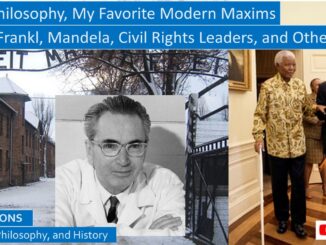
Viktor Frankl’s Logo-therapy, Man’s Search For Meaning in Life, Love, and Suffering

Viktor Frankl’s book, Man’s Search for Meaning, is a life-changing book and one of my favorites, it touched me deeply when I first read it many years ago. The main theme of the book is no matter what challenges you face in your life, or how busy you are, you always have time to be kind to all those whom you encounter, to be a positive influence on the lives whom you touch. Although he does not directly mention stoicism, his account of how he survived Auschwitz is a living example how a stoic mindset can help you survive and thrive through any challenge life may throw at you. […]