Summary of Papacies Between Trent and Vatican II. How Did These Popes Prepare the Way for Vatican II?
History

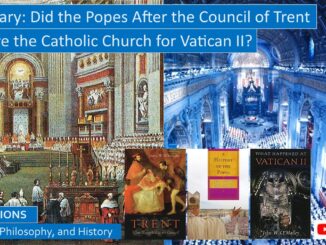
Summary of Papacies Between Trent and Vatican II. How Did These Popes Prepare the Way for Vatican II?

How did the Catholic Church survive the French Revolution, the conquests of Napoleon, and the Revolutions of 1848? Was the Second Vatican Council a continuation of Vatican I? Was Pope Leo XIII, who issued Rerum Novarum, the social justice encyclical that sympathized with the working man, a conservative or a […]

Pope Pius X, Promoting Piety, Rejecting Modernism
History

Pope Pius X, Promoting Piety, Rejecting Modernism

After the long and momentous papacy of Pope Leo XIII, the cardinals sought a candidate who would be a pastoral pope. They chose Guiseppe Sarto, who had spent his entire priestly life as a pastor, last serving as patriarch of Venice. He was from a family of modest means, and for nine years he served as a priest in a country parish. His formal education was meager, he studied at a seminary in Padua.
Our author John O’Malley explains: “Pope Pius X had never set foot outside Italy. He saw things in terms of black and white. While still Patriarch of Venice, he wrote to a friend: ‘When we speak of the Vicar of Christ, we must not quibble. We must obey. We must not evaluate his judgments or criticize his directions lest we do injury to Jesus Christ himself. Society is sick. The one hope, the one remedy, is the pope.’ The words ring like an Ultramontanist manifesto.” […]
History

How Did the Experiences of World War II Influence the Second Vatican Council?

Vatican II marks a shift in the Church’s attitude towards the modern secular world. Gone are the anathemas of the Council of Trent and many other councils that condemn those who may disagree with the teachings of the church, instead Vatican II seeks dialogue with the modern world in with a pastoral rather than a condemning attitude. The Vatican II decree on religious freedom announced that democracy and freedom of religion and conscience were the friends of the church, that a totalitarian form of government could never be a trustworthy friend of the Catholic or Christian Church. […]

History

Pope John XXIII Opening Address to Vatican II, and Yves Congar, True and False Reform, Conclusion

Pope John Paul XXIII opens his speech with:
“A positive proof of the Catholic Church’s vitality is furnished by every single council held in the long course of the centuries.” “And now the Church must once more reaffirm that teaching authority of hers which never fails but will endure until the end of time.”
This echoes Congar’s sentiments that true reform must rediscover the ancient traditions of the church, that the moral teachings never change, but history itself does change, and the church must change with history. […]