Civil Rights

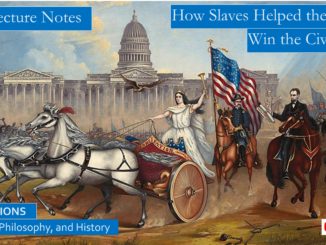
Stories of How Slaves Helped the Union Win the Civil War: Yale Lecture Notes

To win the war, Lincoln drafted the Emancipation Proclamation, shared it with his Cabinet, and then pocketed the document until the fortunes of war improved for the North.  After the victory at the Battle of Antietam and Grant’s victory at Vicksburg, Lincoln released the Emancipation Proclamation as an executive order issued under his war powers as Commander-In-Chief in September 1862.

What the Emancipation Proclamation did not do was emancipate any slaves immediately, nor did it emancipate the slaves in the border states loyal to the Union cause.  Lincoln proclaimed that if the Confederacy surrendered by January 1, 1863, she could keep her slaves, but if the rebellion persisted after that date all slaves in the rebelling states would be free.

David Blight in his lecture says:
There were at least four immediate and visible effects of the Emancipation Proclamation. First, every forward movement the Union armies now would, whether some of those officers liked it or not, liberate more slaves. Second, news of this Proclamation, whatever the details and the fine print, would spread like wildfire across the South, and it would attract towards Union lines more freed people. We have testimony of Confederate soldiers and white Southerners saying they first heard about the Emancipation Proclamation from their slaves. Third, it committed the United States Government in the eyes of the world to Emancipation.  That’s terribly important when we remember that Great Britain was on the verge of recognizing the Confederacy as an independent nation.  Fourth, Lincoln formally authorizes once and for all, although it’s already begun to happen, the recruitment of black men into the Union Armies and Navy, and it authorizes a formal process now to recruit black men to the Union uniform. And before the war will end about ten percent of all Union forces will be African American– approximately 180,000–eighty percent of whom were former slaves, from the slave states. […]
Civil Rights

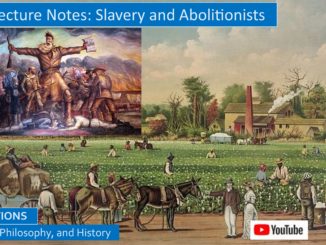
American Slavery and the Abolitionists: Yale Lecture Notes

When Abraham Lincoln met Harriet Beecher Stowe, he remarked, So you are the little lady whose little book started the Civil War.  This book, Uncle Tom’s Cabin, was the best-selling book by far in 1852, eventually selling over a million copies, galvanizing Northern opinion about the horrors of slavery.  This romantic novel from the point of view of ordinary slaves, and it really promoted that the lives of even slaves should have dignity, they were not just mere property like cows or horses, that slaves could the heroes and heroines of a tragic novel allowing the reader to imagine the horrors of a life lived bound in chains, of souls bound in cruel inequities, of human beings bound in a life of unending cruelties.[2]

The antithesis of Uncle Tom’s Cabin was the Supreme Court decision in Dred Scott vs Sanford in 1857.  Dred Scott was a slave who sued his master for his freedom as his master moved him and his family between slave states and free states that banned slavery under the Missouri Compromise law.  The Southern Chief Justice Roger Taney held that no negro had ever enjoyed the rights of a citizen under the Constitution.  Negroes were denied the dignity of personhood, negroes were always property and would also remain property, negroes were declared by the Supreme Court decision to be “so far inferior that they had no rights which a white man was bound to respect.”  This decision, which denied that the Constitution gave Congress the right to bar slavery in the territories, enraged public opinion in the North, bolstering the popularity of Lincoln and the Republican Party […]

History

Slaves in Ancient Greece and Rome, Blog 2

Slavery in the ancient world was not based solely on race like in the Confederate South. Slavery in the ancient world happened to you when your city was conquered or when you were kidnapped by pirates. When a city was defeated the women and children were often enslaved, the men were often slaughtered, though sometimes they were enslaved to work in the mines. Or if you could not pay your bills you could be sold into slavery. […]

History

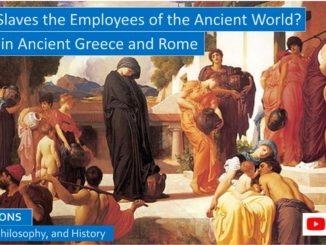
Slaves in the Ancient World, Blog 1, Were Slaves the Employees of the Ancient World?

We are tempted to view slavery as something that went away with the Civil War, that with regards to slavery the modern world is so morally superior to the ancient world. The truth is that there were no employees in the ancient world, that slaves in the ancient worlds did the work that employees are hired to do in today’s world.

To understand the role of slaves in the ancient world we have a totally distorted picture when we only focus on the moral wrong of owning another person, treating servants like talking draft animals. The other aspect of slavery is paying someone such low wages that they cannot feed their family with dignity, that they feel like they live forever on the edge of the abyss, where the slightest crisis could force them to live in the streets. Someone who earns starvation wages is very much a modern-day slave. […]

Early Church Writing

Epistles of St Ignatius to the Romans and Polycarp

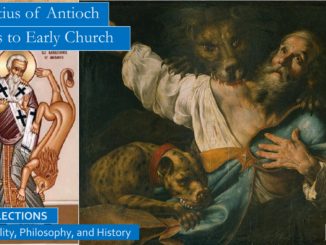
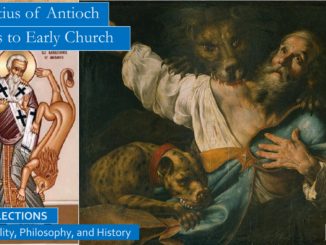
Repeatedly St Ignatius begs the Romans not to seek a pardon to prevent his martyrdom. He writes his rhapsody, “in the fullness of life I am yearning for death with all the passion of a lover. Earthly longings have been crucified; in me there is left no spark of desire for mundane things, but only a murmur of living water that whispers within me, ‘Come to the Father’. There is no pleasure for me in any meats that perish, or in the delights of this life; I am fain for the bread of God, even the flesh of Jesus Christ, who is the seed of David; and for my drink I crave that Blood of His which is Love imperishable.” “I am His wheat, ground fine by the lion’s teeth to be made purest bread for Christ.” […]

Early Church Writing

St Ignatius Epistles to the Ephesians, Magnesians, and Smyrnaeans

The early writings of St Ignatius of Antioch gave the early church a shining example of martyrdom. He was arrested by the authorities for his faith, like St Paul, and was being escorted to Rome to be fed to the wild animals in the arena. During the stops in his journey he received delegations from the various churches who received epistles from him to be read to their flocks. In his epistles to the churches St Ignatius insists that there be unity in the churches, that the members respect the bishops. He also tells them that a liturgy or sacrament that is not blessed by the bishop is not valid, that the faithful should be loyal and obedient to their bishop. These epistles were revered by the early church and were quoted often by the church fathers. […]

History

Iliad Blog 2, Captured Concubines in the Iliad and the Torah

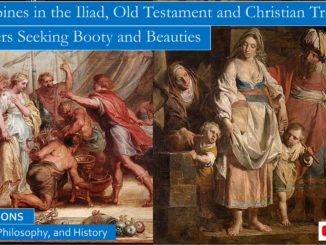
Before attacking Troy, the Greeks first attacked and sacked the cities of their allies surrounding Troy, and carried off many of their young maidens as newfound concubines, King Agamemnon won the young girl Chryseis, while King Achilles won the beauty Briseis. This sound to our ears so brutal, that these men would without a twinge of conscience kidnap young girls in the heat of battle, but yet when we let the poetry of the Iliad sink in we realize that Achilles does truly love Briseis, and when she is taken away he loses his heart for battle. Likewise, Agamemnon professes fondness for Chryseis, with as much fondness as the Iliad permits him, more fondness then for his wife, especially since his wife is home in Greece many fathoms and many years away. […]