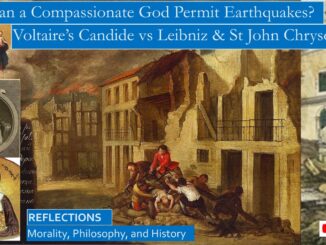
St John Chrysostom, Voltaire, and Leibniz Ask: Why Would a Loving God Permit Earthquakes?
Early Church Writing

St John Chrysostom, Voltaire, and Leibniz Ask: Why Would a Loving God Permit Earthquakes?

Theodicy is the term that Gottfried Leibniz coined in 1710 to describe this so-called problem of how an Almighty God permits suffering in the world.[1] The famed textual critic Bart Ehrman describes how he lost his faith over his concern about Theodicy in his book, On God’s Problem: Why We Suffer. As he points out, different books of the Bible answer this question differently. Many of the prophets, like St John Chrysostom, proclaim that natural disasters are often punishment meted out because we do not take care of the widows, orphans, and the poor.
On the other hand, in the Book of Job God does not give a reason for Job’s suffering, instead asking if Job can fathom the purposes of any of God’s inscrutable actions. why God permits the actions of God.  Although I often do not agree with Bart Ehrman’s conclusions, I rarely disagree with the evidence he cites in his works. Another recent best seller is by Rabbi Harold Kushner: When Bad Things Happen to Good People. We plan to reflect on both these works sometime in 2025. […]
St John Chrysostom On Reading Scriptures, Preaching, and Chariot Races
Eastern Church Fathers

St John Chrysostom On Reading Scriptures, Preaching, and Chariot Races

“What are you saying, man? That attending to the Scriptures is not for you, since you are surrounded by a multitude of cares? Rather it is for you more than them. Monks do not need the help of the divine Scriptures as much as those who are involved in many occupations. The monks, who are released from the clamor of the marketplace and have fixed their huts in the wilderness, who own nothing in common with anyone, but practice wisdom in the calm of that quiet life, as if resting in a harbor, enjoy great security; but we, as if tossing in the midst of the sea, driven by a multitude of sins the continuous aid of the Scriptures.” […]

St John Chrysostom: Lazarus and the Rich Man: When Are the Poor Unworthy? On Wealth and Poverty
Bible Stories and Parables

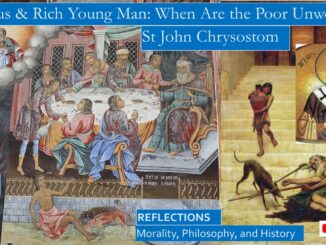
St John Chrysostom: Lazarus and the Rich Man: When Are the Poor Unworthy? On Wealth and Poverty

St John Chrysostom entreats us: “The poor man has one plea:” “Do not require anything else from him; but even if he is the most wicked of all men and is at a loss for his necessary sustenance, let us free him from hunger.”
“Christ also commands us to do this, when He said, ‘Be like your Father in heaven, for He makes His sun rise on both the evil and the good, and sends rain on the just and on the unjust.’ The alms giver is a harbor those in necessity:” “whether they are bad or good or whatever they are who are in danger.”
A virtuous almsgiver is not a judge. “Charity is charity when we give it even to the unworthy.” “Need alone is the poor man’s worthiness.” “For if we investigate the worthiness of our fellow servants, God will do the same for us.” […]

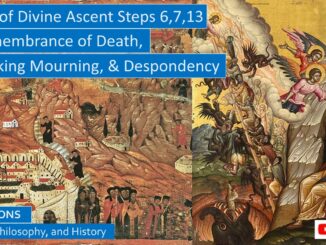
Ladder of Divine Ascent, SMALL Steps 6,7, 13
Ladder of Divine Ascent

Ladder of Divine Ascent, Remembrance of Death, Joy Making Mourning, and Despondency, Steps 6,7, & 13

St John Climacus continues:
Step 6.3. “Fear of death” “comes from disobedience, but trembling at death is a sign of unrepented sins.” Those who fear death the most are the disobedient who live only to party, who live for today, who live for themselves, and do not live for others, they are the unrepentant who tremble at death’s gates. Even “Christ fears death, but does not tremble,” so He can show us that he is both God and man.
Step 6.24. “It is impossible, someone says, impossible to spend the present day devoutly unless we regard it as the last of our whole life.” […]

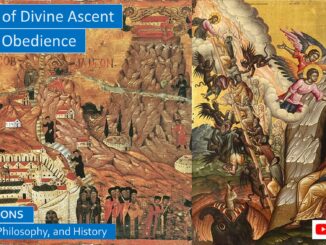
Ladder Of Divine Ascent Step 4 Obedience
Ladder of Divine Ascent

Ladder of Divine Ascent, St John Climacus, Rung 4 on Obedience

Obedience precedes repentance in the Ladder of Divine Ascent. Without obedience, there is no repentance. With repentance comes obedience. When we sinned, we did not obey; now we repent, and obey. It is interesting that in the Decalogue the commandment of honor our father and our mother, and all those in authority, connects the commands to Love God with all our heart and with all of our soul and with all of our everything to the commands to love our neighbor as ourselves.

Step 4.3 As John Climacus teaches us, in obedience we renounce our desires, what we want, what we need: “Obedience is unquestioning movement, voluntary death, a life free of curiosity, carefree danger, unprepared defense before God, fearlessness of death, a safe voyage, a sleeper’s progress. Obedience is the tomb of the will and the resurrection of humility.” […]

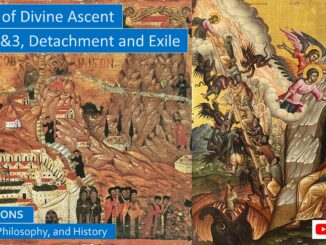
St John Climacus, Ladder of Divine Ascent, On Detachment, Exile, and Pilgrimage, Steps 2 and 3
Ladder of Divine Ascent

St John Climacus, Ladder of Divine Ascent, On Detachment, Exile, and Pilgrimage, Steps 2 and 3

St John Climacus wrote the Ladder of Divine Ascent as a handbook for monks living the monastic life, cut off from the world, in the isolation of the Egyptian desert monasteries, in a world before global communications where the monk could easily call his family on the monastery phone. In […]