
Book Reviews and Miscellaneous

My Favorite Reflections on Morality, Philosophy, and History

Scholars, like most everyone else, are social creatures, and are eager to please their teachers. This means they usually repeat the narratives they have been taught. Additionally, professors are often so hyper-specialized that they overlook connections to other fields. And, as Professor Steven Pinker noted, back in the day, professors dared not study consciousness until they attained tenure.
Is there anything new under the sun? What I hope to find is someone from the past who confirms my insights, because original insights are most valuable when they are old truths long forgotten, or connections are overlooked because prior generations were blind to how current events affected their views. Even when there is no direct confirmation, I sometimes find reflections from past generations that indirectly confirm, or at least do not disprove my perspectives.
For me, creativity is not a problem, so I prefer to include quotes from ancient and modern authors, to encourage my listeners to read them on their own. Why restate aphorisms in my own words when they are so inspiring when originally uttered? The eastern Church Fathers did not see a need to reword inherited ancient teachings, so why should I? […]
Cicero on Friendship and Virtue
Philosophy

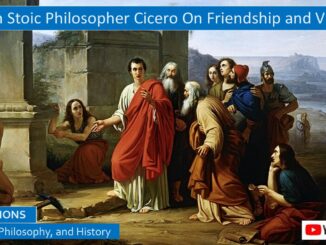
Roman Stoic Philosopher Cicero On Friendship and Virtue

Cicero advises us: “The first and sacred law of friendship: Seek only good from friends, do only good for the sake of friends, and don’t wait to be asked! Be always attentive! Banish hesitation! Be ready to give advice freely! Take seriously the good advice of friends. Be ready to offer it openly, even forcefully, if the occasion demands, and also be ready to follow when it has been offered.”
In contrast, Antisthenes, the first Cynic philosopher who studied under Socrates, advises us: “Pay attention to your enemies, for they are the first to notice your faults.” Often, friends are reluctant to tell us what we need to know, preferring to tell us what they think we want to hear. […]

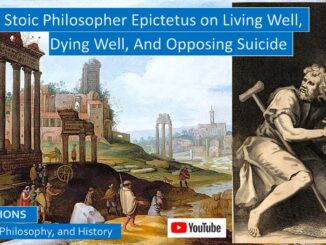
Epictetus, Eminent Roman Stoic Philosopher, on Living Well, Dying Well, and Opposing Suicide
Aging

Epictetus, Eminent Roman Stoic Philosopher, on Living Well, Dying Well, and Opposing Suicide

Is it wise to complain? Epictetus observes: “If someone dies young, he blames the gods because he is being taken before his time. If someone lingers on into extreme old age, he too blames the gods.” “Despite this, at the approach of death, he wants to stay alive; he sends for the doctors and begs him to do all he can.” “It is quite remarkable to see how people want neither to live nor to die.”
“Is health good and illness bad? No, man. What, then? Health managed well is good, but when badly managed, it is bad.”
Epictetus points out: “If you look at yourself in isolation, it is natural for you to live to an old age, to be rich, to be healthy. But if you look at yourself as a human being and as part of some whole, for the sake of that whole, it may be appropriate for you to be ill, or risk your life at sea, or be poor, or die young. Why get angry then?” “What is a human being? A part of a city made up of gods and human beings,” “a small copy of the universal city.” […]

Pope Leo the Great, Confronting Attila the Hun, and His Role in Fourth Ecumenical Council of Chalcedon
Catholic Middle Ages and Beyond

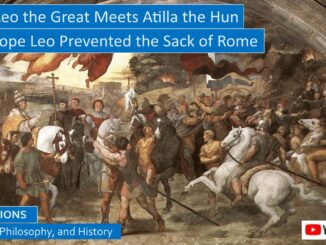
Pope Leo the Great, Confronting Attila the Hun, and His Role in the Fourth Ecumenical Council of Chalcedon

As Pope Benedict XVI writes: “The times in which Pope Leo lived were very difficult: constant barbarian invasions, the gradual weakening of imperial authority in the West, and the long, drawn-out social crisis forced the Bishop of Rome” “to play an important role in both civil and political events.”
“In a period of profound crisis, Leo the Great knew how to make himself close to the people and the faithful with his pastoral action and his preaching. He enlivened charity in a Rome tried by famines, an influx of refugees, injustice, and poverty. He opposed pagan superstitions and actions of Manichaean groups. He associated the liturgy with the daily life of Christians.” […]

Roman Stoic Philosopher Cicero on Aging and Death
Philosophy

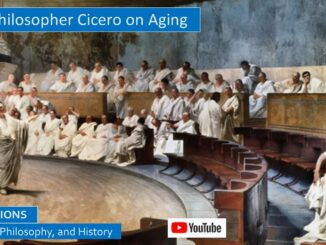
Roman Stoic Philosopher and Politician Cicero on Aging and Death

Cicero advises us: “Enjoy the blessing of strength while you have it, and have no regrets when it has gone, any more than young men should regret the end of boyhood, or those approaching middle age lament the passing of youth. Life’s course is invariable: nature has one path only, and you cannot travel along it more than once. Every stage of life has its own characteristics: boys are feeble, youths in their prime are aggressive, middle-aged men are dignified, while the elderly are mature. Each of these qualities is ordained by nature for harvesting in due season.”
Cicero continues: “Age must be overcome; its faults need vigilant resistance. We must combat them as we should fight a disease: following a fixed regime, exercising in moderation, and consuming enough food and drink to strengthen” but not too much. “The mind and spirit need even more attention than the body, for old age easily extinguishes them, like lamps” with too little oil. […]

Seneca on Aging Death and Suicide
Aging

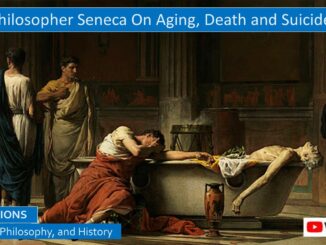
Roman Stoic Philosopher Seneca on Aging, Death, and Suicide

Seneca reminds us: “There is indeed a limit fixed to us,” “but none of us knows how near he is to this limit. Therefore, let us so order our minds as if we had come to the very end. Let us postpone nothing. Let us balance life’s account every day.” “Let us begin at once to live and count each separate day as a separate life.” What is important is “not how long you live, but how nobly you live. And often living nobly means that you cannot live long.” […]

Did Rome Fall, or Evolve to Barbarian Kingdoms? Sack of Rome, and Attila the Hun’s Invasions
Greek and Roman History

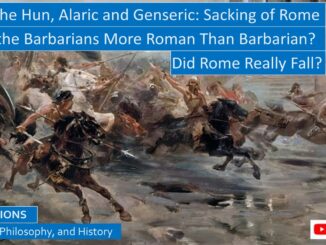
Did Rome Fall, or Evolve Into the Barbarian Kingdoms? Sacks of Rome, and Attila the Hun’s Invasions

Peter Brown contends: “The Roman Empire was not violently breached by barbarian “invasions.” Rather, between AD 200 and 400, the frontier itself changed. From being a defensive region, which kept Romans and barbarians apart, it had become, instead, an extensive middle ground, in which roman and barbarian societies were drawn together. And after AD 400, it was the barbarians and no longer the Romans who became the dominant partners in the middle ground.” Indeed, after AD 400 barbarian tribes served in the army of the Huns, and barbarians from most of the tribes, including the Huns, served in the Roman armies. […]

Was St Paul a Former Slave
Biblical Interpretation

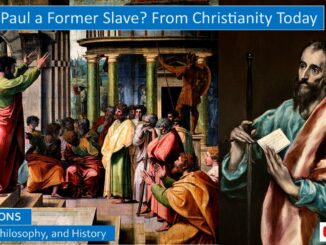
Was St Paul a Former Slave? Were His Parents Enslaved by the Romans?

Our authors in Christianity Today note that several prominent Biblical scholars in past 150 years have speculated that Paul’s parents were enslaved, perhaps in “the uprising in 4 BC, when Varus, Roman governor of Syria, burned entire cities and crucified 2,000 people. In Galilean cities like Sepphoris, Josephus wrote in Antiquities of the Jews, ‘troops made its inhabitants slaves.’” Furthermore, in St Jerome’s commentary on Philemon, written around the end of the fourth century, likely using Origen’s commentary as a source, states St Paul’s parents were Gischala in Judea, and were among the Jews exiled to Tarsus by the Romans. A few centuries later, St Photius, the scholarly bishop of Constantinople, confirms this, adding that St Paul was born to enslaved parents in Tarsus. These ancient sources are highly regarded by modern scholars. […]

The Cruel Roman Emperor Commodus, Son of the Good Stoic Emperor Marcus Aurelius
Greek and Roman History

The Cruel Roman Emperor Commodus, Son of the Good Stoic Emperor Marcus Aurelius

The wise stoic reign of Marcus Aurelius, beloved by all, was followed by the murderous reign of Commodus, hated and feared by all, who would be assassinated by his closest companions. The disastrously reckless cruelty of Commodus, and his neglectful reign, which nearly caused the disintegration of the Roman Empire, colors the opinion of both ancient and modern historians. What historians mention, but do not emphasize, are the similarities between the soldier Hadrian and Commodus. Both liked to fight in the ring as gladiators. Both decided to halt the Roman policy of expansion, seeking strategic withdrawal. And Marcus Aurelius was as wary of his adoptive grandfather Hadrian as he was of his wayward son Commodus. […]

Were the Christians Actively Persecuted by Marcus Aurelius, Stoic Philosopher and Good Roman Emperor?
Greek and Roman History

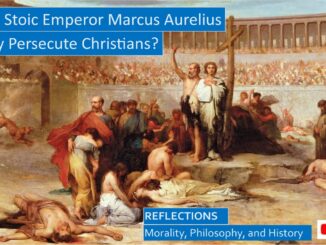
Were the Christians Actively Persecuted by Marcus Aurelius, Stoic Philosopher and Good Roman Emperor?

Today we will reflect on this question: Did the good Roman Emperor and Stoic Philosopher Marcus Aurelius actively persecute Christians? Why wasn’t Marcus Aurelius and other stoics impressed by the martyrdom of Christians in the arena? How could Marcus Aurelius espouse Christian values in his Stoic Meditations, while also including […]