Summary of Youth and Military Career of Ulysses S Grant
Civil War Memories

Summary of Youth, West Point, and Generalship of Ulysses S Grant, From Mexican-American War to Civil War

Those who fought the Civil War grew up in the America of Andrew Jackson, when the giants of the second generation of American leaders fought to hold the United States together. These great orators, including Henry Clay and Daniel Webster, would later inspire Union soldiers to fight and die to preserve the Union. These were the years when the slave-owning Southern President Andrew Jackson threatened to deploy federal troops to prevent the secession of South Carolina over tariffs during the Nullification Crisis in the 1830s. […]
General Ulysses S Grant’s Victory at the Bloody Battle of Shiloh, and His Earlier Civil War Battles
Civil War Memories

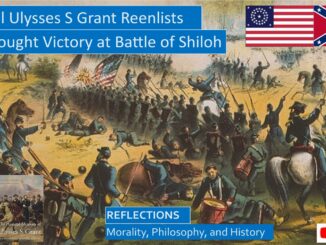
General Ulysses S Grant’s Victory at the Bloody Battle of Shiloh, and His Earlier Civil War Battles

Chernow recounts: “Before Shiloh, Grant had nursed hopes for a titanic battle that would triumphantly crush the rebellion. Now, stunned by the combative spirit of his foes, he knew there would be many more bloodbaths in a long, grinding war of attrition. This began is conversion to a theory of total warfare in which all of southern society would have to be defeated.”
Chernow continues: “For Grant, Shiloh represented a personal victory. He had rescued his army from his own errors, showing a gumption and an audacity that altered the battle’s course. He had shown coolness under fire and a willingness to take monumental gambles. The battle also instilled lasting confidence in the Army of the Tennessee, shattering anew the fighting mystique of rebel soldiers.” […]

Early Life and Career of Ulysses S Grant Through His Service in the Mexican American War
Civil War Memories

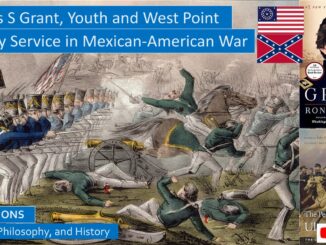
Early Life and Career of Ulysses S Grant Through His Service in the Mexican American War

What was young Ulysses like? Chernow says that in his youth, Ulysses “seemed forgettable and colorless,” was not wayward or rambunctious or mischievous. “Like his mother, he was self-contained, as if he had trained his face to mask emotion and keep his inner life secret. Like Hannah, he was uncommonly even-tempered.” Unlike many great men of history, Ulysses in his youth had no vision of a great future and was prepared to live his life in obscurity. He was underestimated by many who met him.
Chernow describes traits that would serve him well later in life. “Never one to initiate a fight, he refused to back down when bullied. He was roused to fury if sadistic boys tormented an innocent child or a defenseless horse, and small boys embraced him as their steadfast protector.”
Ulysses was born with a love for horses. Chernow notes: “He liked to ride without a saddle or stirrups, sitting astride a blanket on the horse’s back, and he was so expert at handling horses that he began riding at age five. He became known for breaking in wild horses for local farmers.” “He tamed even the most refractory horses through a fine sensitivity to their nature rather than by his physical prowess.” […]

Who Were More Violent: Black Civil Rights Protestors or White Supremacists?
Civil Rights

Who Were More Violent: Black Civil Rights Protestors or White Supremacists?

We had a recent comment on the somewhat peaceful protests organized by Martin Luther King and other civil rights leaders during the tumultuous decade of the Sixties: “They were violent rioters, not peaceful protesters.” How violent were these protesters, and how violent where the white supremacists they were confronting? And […]

Redemption Era of Jim Crow, Reconstruction Ends after Contested 1876 Election
Civil War and Reconstruction

After Grant: Southern Redemption and Jim Crow, Reconstruction Ends after Contested 1876 Election

What were his greatest accomplishments? Chernow states that “Grant showed a deep reservoir of courage in directing the fight against the Ku Klux Klan and crushing the largest wave of domestic terrorism in American history. It was Grant who helped to weave the Thirteenth, Fourteenth, and Fifteen Amendments into the basic fabric of American life.”
Chernow rues: “Once Reconstruction collapsed, it left southern blacks for eighty years at the mercy of Jim Crow segregation, lynchings, poll taxes, literacy tests, and other tactics designed to segregate them from whites and deny them the vote. Black sharecroppers would be degraded to the level of debt-ridden serfs, bound to their former plantation owners. After 1877, the black community in the South steadily lost ground until a rigid apartheid separated the races completely, a terrible state of affairs that would not be fixed until the rise of the civil rights movement after World War II.” […]

President Ulysses S Grant, White Supremacy Triumphs, and Gilded Age Corruption During his Second Term
Civil War and Reconstruction

President Ulysses S Grant, White Supremacy Triumphs, and Gilded Age Corruption During his Second Term

Why was President Grant easily reelected to second term, when there were so many problems faced in his first term? Why did the Liberal Republican Party become a third party? Was it truly liberal? Why did the Union Army fight several battles in Louisiana after the Civil War? How did […]

President Ulysses S Grant, First Term, Battling the KKK, Fighting for Civil Rights
Civil War and Reconstruction

President Ulysses S Grant, First Term, Defeating the KKK, Fighting for Civil Rights

Ulysses S Grant won the presidential race handily. Although he won only 53% of the popular vote, he won the electoral college vote by a landslide, 214-80. “Bolstered by black and white carpetbagger votes, all southern states, with the notable exception of Georgia and Louisiana, where Klan violence was rife, tumbled into the Republican column. White violence had also diminished Republican turnout in Tennessee, Alabama, and South Carolina.”
Grant’s acceptance speech was curt, as usual. “The responsibilities of the position I feel, but accept them without fear, if I can have the same support which has been given to me thus far.”
Former General Grant too often made decisions without asking for advice from more politically astute advisors, behaving like a general fearful of leaks tipping off enemy forces. His success as a general made him too complacent. Many years later, in hindsight, Grant expressed his regrets. “I entered the White House as President without any previous experience either in civil or political life. I thought I could run the government of the United States as I did the staff of my army. It was my mistake, and it led me into other mistakes.” […]

Atlantic Magazine Endorses Kamala Harris: Are Migrants To Blame? When Did Kamala Turn Black?
Current Events and History

Atlantic Magazine Endorses Kamala Harris: Are Migrants To Blame? When Did Kamala Turn Black?

Compare what he said when he announced his candidacy when going down the escalator in Trump Tower in 2015 to his infamous quote in the Presidential Debate:
Trump, 2015: “When Mexico sends its people, they’re not sending their best. They’re sending people that have lots of problems, and they’re bringing those problems with them. They’re bringing drugs. They’re bringing crime. They’re rapists. And some, I assume, are good people.”
Trump, 2024: “In Springfield, (the Haitians) are eating the DAWGS. The people that came in. They’re eating the cats. They’re eating, they’re eating the pets of the people that live there. And this is what’s happening in our country. And it’s a shame.”
The Atlantic Magazine confirms this in another recent column, on how “The Trump Campaign Wants Everyone Talking About Race. The former president and his advisers’ strategy is to make white voters afraid, and they don’t care if they have to lie to do it.” […]

General Grant Post-Civil War and Reconstruction
Civil War and Reconstruction

General Grant Supporting Civil Rights and Reconstruction After the Civil War, and His Conflicts with Andrew Johnson

When the new Congress convened, the House Judiciary Committee voted by a 5 to 4 vote to impeach President Johnson. When the Senate overwhelmingly voted to restore Stanton as Secretary of War, Grant vacated his interim position. In the upcoming political struggle, as Chernow relates, “The worse things looked for Andrew Johnson, the brighter was the political future for Grant. In early February, the New York Republican Convention endorsed Grant for President.”
During the Senate trial, Grant argued privately with Congressmen on the need to convict Johnson, but he thought it would be inappropriate for him to appear during the Senate trial. Chernow puts it best: “During the war, Grant had learned that it was better to let power seek him rather than to pursue it; a good general waited to be summoned by his superiors.”
In the end, Johnson was acquitted by one vote. Seven Republicans in total voted to acquit, as they did not think that Johnson’s actions were not the high crimes and misdemeanors that the Constitution declared were needed for impeachment. Ulysses S Grant would handily win the 1868 Presidential election, and Grant’s Presidency will be featured in a future reflection. […]

States' Rights v Federal Power From the Nation's Founding to Civil War, Jim Crow, and Civil Rights Movement
Civil Rights

States’ Rights v Federal Power From the Nation’s Founding to Civil War, Jim Crow, and Civil Rights Movement

The Constitution was drafted to correct the many weaknesses of the Articles of Confederation. Congressmen now swear allegiance to the United States rather than to their native states, as was done under the Articles. The Constitution grants the Federal government not only the power to levy taxes, but also to collect them, as well as sole control over trade and commerce. The Constitution establishes a Federal court system that can override state court decisions if there is a conflict. The US Congress, unlike the Confederation Congress, can pass routine legislation with a simple majority vote. […]