Paul Tournier, Christian Psychologist on Marriage and Widows in Old Age and Retirement
Aging

Paul Tournier, Christian Psychologist on Marriage and Widows in Old Age and Retirement

What is the ideal, according to Paul Tournier? “Growing old together, husband and wife can come to know a love which is, in a way, a prefiguration of heaven, for it is less tumultuous than the love of youth, being less directed towards selfish pleasure-seeking, and because a slow advance in mutual comprehension permits more authentic communication.” […]

Classical Christian Psychologist Paul Tournier on Old Age, Death, and Faith
Aging

Classical Christian Psychologist Paul Tournier on Old Age, Death, and Faith

Tournier reminds us that we may experience many successes, but as we grow older, “success retreats, and escapes us, it is limited, unfulfilled.” “When one comes to the end, a man’s life is nothing much.” “Professional life is over, and it finishes unfinished. This is a prefiguration of death, in which the whole of life will finish it, too, being unfinished. That is the dramatic contradiction of death.” Quoting Robert Mehl: “An end, but not a fulfilment, that is the face of death.” […]

Paul Tournier on Aging and Retirement
Aging

Classical Christian Psychologist Paul Tournier on Old Age and Retirement

Paul Tournier notes: “Freud defined psychological health under the double heading of aptitude for love and for work.” But Paul Tournier cautions that “the superficial relationships of working life and of sexual attraction must lead to a deeper personal commitment. And I believe that no commitment can be truly personal unless it takes on a transcendent dimension and become love, in the biblical meaning of the word.”
Paul Tournier is grateful: “As an intellectual, I am specially privileged. It is true that the better educated people are, the more chance they have to enjoy their retirement. First, intellectual work” is not physically taxing. “Second, the capacity for intellectual work is retained longer than physical ability. It can even increase in old age as long as disease does not affect the mental faculties. But most of all, the more one exercises one’s mind, the more pleasure it gives to exercise it. The more one learns, the more one wants to learn, and the easier study becomes.” […]

What are the Ten Early Signs and Symptoms of Alzheimer's?
Dementia and Alzheimers Disease

What are the Ten Early Signs and Symptoms of Alzheimer’s?

What are the Ten Early Signs and Symptoms of Alzheimer’s? We repeat these ten warning signs from the Alzheimer’s Association website in our book review of Kim Campbell’s biography of the celebrity country music star Glen Campbell from before his diagnosis of Alzheimer’s disease through his passing. We reflected on […]

Facing the Nazi Menace: CS Lewis' Mere Christianity and Viktor Frankl's Man's Search for Meaning
CS Lewis

Facing the Nazi Menace: CS Lewis’ Mere Christianity and Viktor Frankl’s Man’s Search for Meaning

Mere Christianity was compiled from a series of radio addresses by CS Lewis explaining the tenets of Christianity which were broadcast during the dark days of World War II, when Londoners fled to the safety of the underground subway tunnels while Nazi bombers destroyed their homes above. We will reflect on the many instances where CS Lewis referred often to this monumental struggle, one of the rare political struggles that actually pitted the forces of good and evil against each other, in Mere Christianity. […]

How Do We Treat our Neighbors Who Suffer From Dementia? Also, Guidance for Over-55 Condos
Dementia and Alzheimers Disease

How Should We Treat our Neighbors Who Suffer From Dementia? Also, Guidance for Over-55 Condos

The challenge facing all of us is the difficulty in distinguishing between the elderly who have dementia from those who are cantankerous or troublemakers. Indeed, even the experts may not be able to tell when dementia is in its earliest stages. So be patient with cantankerous elderly neighbors, they might be suffering from early-stage dementia, evaluate whether they have enough to eat and drink. Be quick to call the police and welfare agencies to evaluate the situation, but in Florida and other states, the police need to be the first contact.

You cannot even say that since this person has a long history of being a troublemaker, then this person is not in an early stage of dementia. Dementia is not like the common cold, when today you have a cold, and yesterday you did not. Dementia often progresses slowly, which means that the personality of someone with dementia does not change as much as it evolves, and often their worse behavior will worsen. Someone who is angry will often simply become angrier. Often their actions are captive to their emotions, which means that the person with advanced dementia literally cannot be blamed for their actions. […]
Modern Stoic Philosophers: My Favorite Maxims: Viktor Frankl, Nelson Mandela, and Others
Philosophy

Modern Stoic Philosophers: My Favorite Maxims: Viktor Frankl, Nelson Mandela, and Others

Why don’t the Roman Stoics discuss justice as much as Plato? In the direct Radical Democracy of Athens, the citizens served on the juries and passed the laws, which meant that ordinary citizens participated in rendering justice. This is why Socrates sought to educate ordinary citizens on justice. But in the Roman Empire, the totalitarian Emperors and their servants were responsible for the administration of justice, the ordinary citizens no longer directly influenced the administration of justice. But that is not the case in modern America and most democracies, many ordinary citizens serve on juries and vote for many political officials, local and national. Justice should be our concern.
You can make a strong argument that Stoicism, like Judaism and Christianity, is founded on the two-fold Love of God and neighbor, that you should Love God with all your heart and all your soul and all your mind and all your strength and love your neighbor as yourself. Plus, we have the St Maximus the Confessor corollary, that we should be eager to forgive our neighbor. […]

Problems Family Caretakers Face When Caring for Loved Ones Suffering From Dementia
Dementia and Alzheimers Disease

Problems Family Caregivers Face When Caring for Loved Ones Suffering From Dementia

This book compares the dance between the dementia patient and the loved ones who are their caretakers where they seem to have the same arguments over and over again, the “Alzheimer’s patients seem unable to learn from their mistakes. But it is also, because, weirdly enough, caregivers experience the same problem. In an uncanny mirroring, we get pulled into a parallel process with our charges, forgetting what happened yesterday, repeating what didn’t work last time, becoming ever more prone to agitation and impatience, even as we’re engaged in a trial of devotion that pushes love to its limit.” […]

Tony Bennett and Rita Hayworth: Their Struggle With Alzheimer's
Dementia and Alzheimers Disease

Tony Bennett and Rita Hayworth: Their Struggle With Alzheimer’s

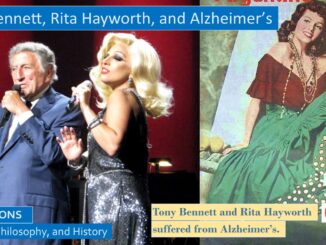
“Tony Bennett was already showing clear signs of the disease, Susan said, when he and Lady Gaga started recording the new LP at New York’s Electric Lady Studios two years after his diagnosis. Indeed, Susan was not entirely sure that Tony was up to the task. ‘We’ll try,’ she recalled telling Danny. ‘That’s all I can tell you. We’ll try.’”
“Tony was a considerably more muted presence during the recording of the new album with Lady Gaga. In raw documentary footage of the sessions, he speaks rarely, and when he does his words are halting; at times, he seems lost and bewildered. Lady Gaga, clearly aware of his condition, keeps her utterances short and simple (as is recommended by experts in the disease when talking to Alzheimer’s patients). ‘You sound so good, Tony,’ she tells him at one point. ‘Thanks,’ is his one-word response.” […]

Summary of St Augustine’s Confessions of Faith and Repentance
Morality

Summary of St Augustine’s Confessions of Faith and Repentance

The Confessions are both a testimonial and a prayer. St Augustine tells us how he embraced Christianity after he was active in the Manichean sect, a New Age dualistic system where good and evil competed more or less evenly, and where Jesus was totally divine without a trace of mortality. St Augustine had many of the same questions that we hear atheists and agnostics raise today, such as: How can intelligent and sophisticated men believe in superstitions about an Almighty God? How can God be Almighty when sin has such a hold in the world? What is the nature of evil? […]