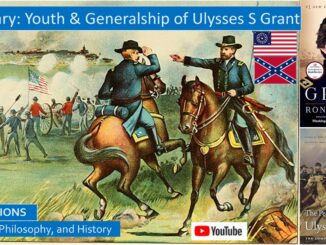
Summary of Youth and Military Career of Ulysses S Grant
Civil War Memories

Summary of Youth, West Point, and Generalship of Ulysses S Grant, From Mexican-American War to Civil War

Those who fought the Civil War grew up in the America of Andrew Jackson, when the giants of the second generation of American leaders fought to hold the United States together. These great orators, including Henry Clay and Daniel Webster, would later inspire Union soldiers to fight and die to preserve the Union. These were the years when the slave-owning Southern President Andrew Jackson threatened to deploy federal troops to prevent the secession of South Carolina over tariffs during the Nullification Crisis in the 1830s. […]
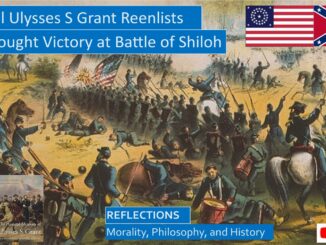
General Ulysses S Grant’s Victory at the Bloody Battle of Shiloh, and His Earlier Civil War Battles
Civil War Memories

General Ulysses S Grant’s Victory at the Bloody Battle of Shiloh, and His Earlier Civil War Battles

Chernow recounts: “Before Shiloh, Grant had nursed hopes for a titanic battle that would triumphantly crush the rebellion. Now, stunned by the combative spirit of his foes, he knew there would be many more bloodbaths in a long, grinding war of attrition. This began is conversion to a theory of total warfare in which all of southern society would have to be defeated.”
Chernow continues: “For Grant, Shiloh represented a personal victory. He had rescued his army from his own errors, showing a gumption and an audacity that altered the battle’s course. He had shown coolness under fire and a willingness to take monumental gambles. The battle also instilled lasting confidence in the Army of the Tennessee, shattering anew the fighting mystique of rebel soldiers.” […]

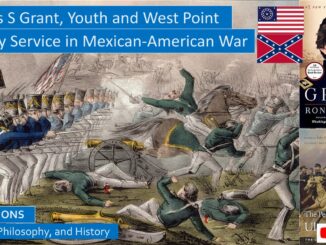
Early Life and Career of Ulysses S Grant Through His Service in the Mexican American War
Civil War Memories

Early Life and Career of Ulysses S Grant Through His Service in the Mexican American War

What was young Ulysses like? Chernow says that in his youth, Ulysses “seemed forgettable and colorless,” was not wayward or rambunctious or mischievous. “Like his mother, he was self-contained, as if he had trained his face to mask emotion and keep his inner life secret. Like Hannah, he was uncommonly even-tempered.” Unlike many great men of history, Ulysses in his youth had no vision of a great future and was prepared to live his life in obscurity. He was underestimated by many who met him.
Chernow describes traits that would serve him well later in life. “Never one to initiate a fight, he refused to back down when bullied. He was roused to fury if sadistic boys tormented an innocent child or a defenseless horse, and small boys embraced him as their steadfast protector.”
Ulysses was born with a love for horses. Chernow notes: “He liked to ride without a saddle or stirrups, sitting astride a blanket on the horse’s back, and he was so expert at handling horses that he began riding at age five. He became known for breaking in wild horses for local farmers.” “He tamed even the most refractory horses through a fine sensitivity to their nature rather than by his physical prowess.” […]

President Grant's Indian Policy, and Custer's Battle of Little Bighorn
Civil War and Reconstruction

President Ulysses Grant’s Indian Policy, and Custer’s Defeat at the Battle of Little Bighorn

Custer had a reputation for cruelty to both Indians and to his own men. Chernow notes: “In 1867, Custer was court-martialed for ordering deserters to be shot and Grant thought he was guilty. The following year, Custer and his cavalry obliterated an Indian village,” “wantonly murdering more than a hundred Southern Cheyenne, including women and children.”
Grant told Sherman and Sheridan that he did not want Custer to lead a force in the campaign against the Sioux Sitting Bull and Crazy Horse. Custer had the chutzpah to request a personal interview with Grant at the White House to appeal this decision, but Grant refused to meet with him. But with Sheridan’s intervention, Grant gave in and allowed Custer to join the expedition against the Indians. […]

General Longstreet and Reconstruction
Civil Rights

Terror During Reconstruction, White League Confronts General Longstreet and Union Army

We will tell the stories of General Longstreet and the Union Major Merrill. General James Longstreet, a former Confederate general who had become a pariah in the South when he changed his party affiliation to Lincoln’s Republican Party, tried to prevent the insurrection in New Orleans. For his second posting during Reconstruction, Major Merrill attempted to reverse the insurrection of parishes on the outskirts of New Orleans. […]

Civil Rights

Chaos of Reconstruction, Terror After the Civil War

Major Merrill says that he knew that the “Ku Klux Klan is much greater in numbers than is commonly supposed, and that a large number of the most respectable people in the county are more or less intimately connected with it. The debauched sentiment of the old slave-holding communities sees no great offense in whipping a negro for being a radical. The old sentiment is rife, where differences of opinion are settled by killing the man who dares to disagree with them.” […]