Summary of Papacies Between Trent and Vatican II. How Did These Popes Prepare the Way for Vatican II?
History

Summary of Papacies Between Trent and Vatican II. How Did These Popes Prepare the Way for Vatican II?

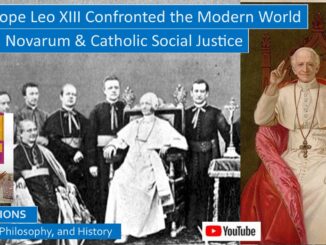
How did the Catholic Church survive the French Revolution, the conquests of Napoleon, and the Revolutions of 1848? Was the Second Vatican Council a continuation of Vatican I? Was Pope Leo XIII, who issued Rerum Novarum, the social justice encyclical that sympathized with the working man, a conservative or a […]

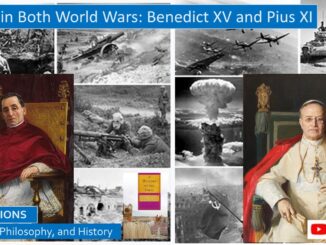
Pope Benedict XV and Pope Pius XI: Confronting World War I and World War II, and Fascism
History

Pope Benedict XV and Pope Pius XI: Confronting World War I and World War II, and Fascism

Mussolini signaled in a speech that he was open to negotiating the Roman question. Mussolini was not a practicing Catholic and was famously a serial philanderer. Like Napoleon before him, Mussolini realized that it was in his political interest to settle this issue and regularize the status of the Vatican City.
O’Malley writes: “The most momentous aspect of the Lateran Agreements was the establishment of the Vatican City as a fully independent and sovereign state, with its own postal service, police force, full diplomatic corps, and so forth. The Italian state agreed never to interfere in the free functioning of Vatican City and ensured full and safe access to it by anyone the papacy wanted to receive. The papacy agreed never to try directly or indirectly to reestablish the Papal States, and it relinquished in perpetuity all claim to the city of Rome.”
The Vatican was paid a generous indemnity for the loss of this territory, and the state would pay an annual stipend for the upkeep of historical monuments. In addition to the 103 acres in Vatican City, the pope could also use several churches and castles traditionally at the church’s disposal. […]

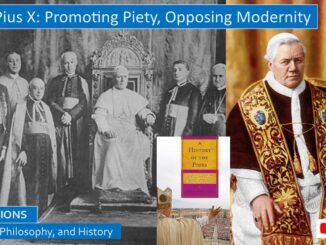
Pope Pius X, Promoting Piety, Rejecting Modernism
History

Pope Pius X, Promoting Piety, Rejecting Modernism

After the long and momentous papacy of Pope Leo XIII, the cardinals sought a candidate who would be a pastoral pope. They chose Guiseppe Sarto, who had spent his entire priestly life as a pastor, last serving as patriarch of Venice. He was from a family of modest means, and for nine years he served as a priest in a country parish. His formal education was meager, he studied at a seminary in Padua.
Our author John O’Malley explains: “Pope Pius X had never set foot outside Italy. He saw things in terms of black and white. While still Patriarch of Venice, he wrote to a friend: ‘When we speak of the Vicar of Christ, we must not quibble. We must obey. We must not evaluate his judgments or criticize his directions lest we do injury to Jesus Christ himself. Society is sick. The one hope, the one remedy, is the pope.’ The words ring like an Ultramontanist manifesto.” […]

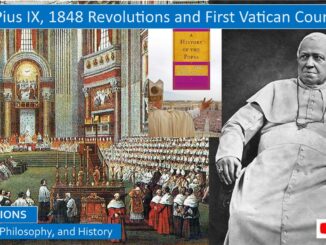
Pope Pius IX, 1848 Revolutions and First Vatican Council
History

Pope Pius IX, 1848 Revolutions and First Vatican Council

Why did Pope Pius IX call the council? John O’Malley notes: “Some people speculated he wanted it solemnly to confirm the Syllabus of Errors. He may have wanted it as a show of Catholic strength worldwide against the church’s enemies, especially in Italy.”
O’Malley continues: “Despite the broad agenda that was anticipated, the council dealt with only two items. The first was the relationship between revealed truth and the powers of human reason.” The council affirmed both the distinction and compatibility between them. With that resolved, the council planned to discuss “church-state relations and the role of the bishops, but with the encouragement of Pius it bypassed them and moved directly to consider” “papal primacy and papal infallibility.”
Papal primacy was not new; the Catholic Church had held this view for fifteen hundred years. But the pope and many bishops felt that the church needed to definitively state that the pope had full authority, not only over matters of faith and morals, but also over discipline and governance for the church worldwide, for both clergy and laity. […]

St Augustine’s On Christian Teaching and JD Vance, Order of Love
Politics

St Augustine’s On Christian Teaching and JD Vance, Order of Love

St Augustine clearly teaches us: “All people should be loved equally. But you cannot do good to all people equally, so you should take particular thought for those who, as if by lot, happen to be particularly close to you in terms of place, time, or any other circumstances.”
St Augustine explains further: “Suppose you have plenty of something which had to be given to someone in need but could not be given to two people, and you met two people,” you could flip a coin for who would receive it. But if one of them was a relative, Jesus would not object if you benefited him. In other words, if your children are starving, you need not share what little food you have with strangers.
Should we love everyone, even our enemies? Definitely, Christians are exhorted to love their enemies. As St Augustine teaches us: “We do not fear our enemies, for they do not take away from us what we love, but we pity them, for they hate us all the more because they are separated from the one we love,” since they are separated from God. […]
Pope Leo XIV, First American Pope, Successor to Pope Francis and Social Justice of Pop Leo XIII
Modern Catholic Popes

Pope Leo XIV, First American Pope, Successor to Pope Francis and Social Justice of Pope Leo XIII

Pope Leo XIV notes: “What is striking about these two attitudes is their relevance today. They embody notions that we could easily find on the lips of many men and women in our own time, even if, while essentially identical, they are expressed in different language.”
“Even today, there are many settings in which the Christian faith is considered absurd, meant for the weak and unintelligent. Settings where other securities are preferred, like technology, money, success, power, or pleasure.” […]