Psychology

Reflections on Mental Health Awareness, and Sunrise Rotary Speakers 2024/2025

What would happen if the demented patient is turned out in the street by the eviction? If a lost and wandering dementia patient is not found within two days, there is a one in four chance they will be found face down in a ditch or canal. But if someone is not looking for a demented patient, the odds are worse. […]

Criminology

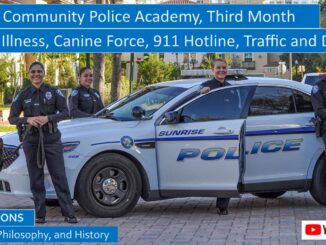
Sunrise Community Police Academy: Police and Mental Health, Canine Officers, 911 Call Center

On homicide week in our Sunrise Community Police Academy, the police instructor showed us the ghoulish face of a dementia patient found face down in a canal. The officer commented that for some strange reason, dementia patients have a strange attraction to water, often drowning.
Roughly sixty percent of dementia patients wander. Experts note that when someone suffering from dementia wanders away, one in four will lose their lives if they are not found within two days. This is why police urge citizens to report a missing person sooner rather than later. […]

Sunrise Police Academy 2 SMALL
Criminology

Sunrise Community Police Academy: What is New? Cameras, Technology, Guns, SWAT Team, and More

Caution is a policeman’s main defense against bullets headed their way. Police are rarely in a rush to approach the driver during a traffic stop, nor are they in a rush to knock on the door for a domestic dispute call. If possible, they wait until other policemen arrive. The more backup, the better.
I was surprised to learn how policemen respond to other police pulling them over when they are in other jurisdictions. They politely roll down their windows, put their hands on their steering wheels, and tell them that they too are police officers. They volunteer where they have their guns, which all policemen carry. They don’t put any documentation in the glove box, because they don’t want to reach in to grab it. […]

How Do We Treat our Neighbors Who Suffer From Dementia? Also, Guidance for Over-55 Condos
Dementia and Alzheimers Disease

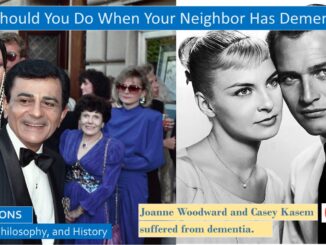
How Should We Treat our Neighbors Who Suffer From Dementia? Also, Guidance for Over-55 Condos

The challenge facing all of us is the difficulty in distinguishing between the elderly who have dementia from those who are cantankerous or troublemakers. Indeed, even the experts may not be able to tell when dementia is in its earliest stages. So be patient with cantankerous elderly neighbors, they might be suffering from early-stage dementia, evaluate whether they have enough to eat and drink. Be quick to call the police and welfare agencies to evaluate the situation, but in Florida and other states, the police need to be the first contact.

You cannot even say that since this person has a long history of being a troublemaker, then this person is not in an early stage of dementia. Dementia is not like the common cold, when today you have a cold, and yesterday you did not. Dementia often progresses slowly, which means that the personality of someone with dementia does not change as much as it evolves, and often their worse behavior will worsen. Someone who is angry will often simply become angrier. Often their actions are captive to their emotions, which means that the person with advanced dementia literally cannot be blamed for their actions. […]

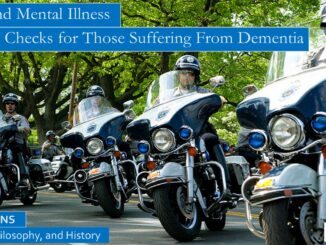
Wellness Checks for Dementia: Police and Mental Illness
Dementia and Alzheimers Disease

Wellness Checks for Dementia: Police and Mental Illness

I joke with the members of my over-55 community that if one of our elderly neighbors is ornery, that we should be patient with them, as they may suffering from dementia, and we do not know it. This is literally true. While you can often sense if someone is autistic, or has a drug problem, or is schizophrenic, often you cannot tell if someone is in the early stages of dementia. […]

Dementia and Foreclosure Story SMALL
Dementia and Alzheimers Disease

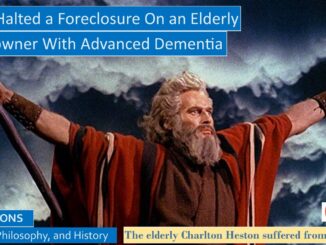
How I Halted Foreclosure on Owner With Advanced Dementia, Reflecting on Dementia

There are brain scans and other tests that doctors can run to confirm the existence of dementia in the elderly who appear to be misbehaving and are an irritation to the community. These diagnoses are not solely dependent on judgmental observations of behavior, though this is a secondary indication. If someone is behaving strangely, have them tested, don’t just assume that they are in full control of their actions. […]