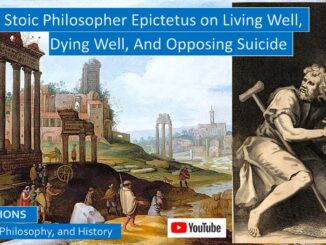
Epictetus, Eminent Roman Stoic Philosopher, on Living Well, Dying Well, and Opposing Suicide
Aging

Epictetus, Eminent Roman Stoic Philosopher, on Living Well, Dying Well, and Opposing Suicide

Is it wise to complain? Epictetus observes: “If someone dies young, he blames the gods because he is being taken before his time. If someone lingers on into extreme old age, he too blames the gods.” “Despite this, at the approach of death, he wants to stay alive; he sends for the doctors and begs him to do all he can.” “It is quite remarkable to see how people want neither to live nor to die.”
“Is health good and illness bad? No, man. What, then? Health managed well is good, but when badly managed, it is bad.”
Epictetus points out: “If you look at yourself in isolation, it is natural for you to live to an old age, to be rich, to be healthy. But if you look at yourself as a human being and as part of some whole, for the sake of that whole, it may be appropriate for you to be ill, or risk your life at sea, or be poor, or die young. Why get angry then?” “What is a human being? A part of a city made up of gods and human beings,” “a small copy of the universal city.” […]
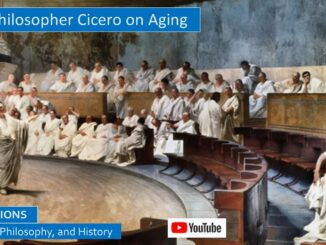
Roman Stoic Philosopher Cicero on Aging and Death
Philosophy

Roman Stoic Philosopher and Politician Cicero on Aging and Death

Cicero advises us: “Enjoy the blessing of strength while you have it, and have no regrets when it has gone, any more than young men should regret the end of boyhood, or those approaching middle age lament the passing of youth. Life’s course is invariable: nature has one path only, and you cannot travel along it more than once. Every stage of life has its own characteristics: boys are feeble, youths in their prime are aggressive, middle-aged men are dignified, while the elderly are mature. Each of these qualities is ordained by nature for harvesting in due season.”
Cicero continues: “Age must be overcome; its faults need vigilant resistance. We must combat them as we should fight a disease: following a fixed regime, exercising in moderation, and consuming enough food and drink to strengthen” but not too much. “The mind and spirit need even more attention than the body, for old age easily extinguishes them, like lamps” with too little oil. […]

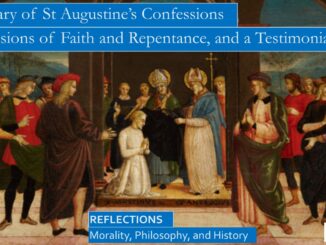
Summary of St Augustine’s Confessions of Faith and Repentance
Morality

Summary of St Augustine’s Confessions of Faith and Repentance

The Confessions are both a testimonial and a prayer. St Augustine tells us how he embraced Christianity after he was active in the Manichean sect, a New Age dualistic system where good and evil competed more or less evenly, and where Jesus was totally divine without a trace of mortality. St Augustine had many of the same questions that we hear atheists and agnostics raise today, such as: How can intelligent and sophisticated men believe in superstitions about an Almighty God? How can God be Almighty when sin has such a hold in the world? What is the nature of evil? […]

St Augustine Confessions Book 10
Morality

St Augustine’s Confessions: On Soul, Mind, Memory, Stoicism, Salvation, and True Happiness, Book 10

St Augustine is my favorite Catholic saint because in every major work he explicitly states that the foundation of the Christian faith is the two-fold Love of God, and love of neighbor, where we love our neighbors as ourselves. In Book 10 St Augustine prays to God that “you want us not only to Love you, but also to love our neighbor,” and he repeats this in other books of the Confessions. St Augustine prays to God: “Give me the grace to do as you command, and command me to do as you will!” […]

Command 5 Do Not Adulter

St Augustine on Concupiscence, Blog 3, Final Reflections

The church teaches that what gives marriage purpose is the bearing of children, so we do not live our lives for ourselves. Salvation is the purpose of marriage, the salvation of our children, the salvation of our spouse, and the working out of our salvation. How does the command to love our neighbor as ourselves work its way out in marriage? We should consider first the good of our children in the living of our lives, then we should work for the good of our spouse, and we should take care of ourselves, but we are last. But last of all in a marriage should be concupiscence, but we should not neglect loving kindness and tenderness, that should pervade all the relationships with our children and with our husband or wife. […]

Command 5 Do Not Adulter

St Augustine on Concupiscence, Blog 2

St Augustine starts his discussion on “On the Good of Marriage” with a discussion how marriage is first a friendship in bonds of family, and a friendship between man and wife, friends who walk together, side by side, raising children, growing old together. St Augustine is a bit harsher in “Marriage and Concupiscence,” teaching that “in matrimony, let these nuptial blessings b the objects of our love – offspring, fidelity, the sacramental bond.” This sacramental bond is meant to be ever-enduring, “lost neither by divorce nor by adultery, and should be guarded by husband and wife with concord and charity.” […]

Command 5 Do Not Adulter

St Augustine on Concupiscence, Blog 1

St Augustine’s most famous quote, made before his ultimate conversion, was a prayer to God, “Please, Lord, grant me chastity, but not yet.” This shows that St Augustine was quite human, just like us, and quite honest about his struggles with intimacy. Let us give St Augustine the benefit of the doubt, let us read him hagiographically, for even though the modern world with modern technology differs greatly from the world of the ancient Christian, St Augustine has much to teach us, and we can benefit from his teaching, finding purpose in our family life, working out our salvation through the raising of our children and through our relationships with our spouse and other family members and close friends. […]