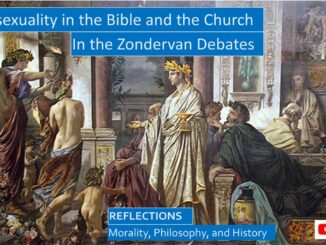
Homosexuality, the Bible, and the Church: The Zondervan Debates
christianity

Homosexuality, the Bible, and the Church: The Zondervan Debates

For better or worse, most of us choose our intimate partners, and build our world around that choice. If a homosexual couple is accepted by the clergy of your church, what good can come from telling them they are going to burn in hell if they do not repent? We are only responsible for our own personal salvation, it is not our job, particularly if we are laymen, to speculate on whether our neighbor will be saved. That is between them and Jesus, and nobody else.
My goal is not to change your mind about homosexuality. My goal is: If you do not accept that it is possible to be both a Christian and homosexual, that you will refrain from telling them they are damned to burn in hell, but would instead refer them to an Episcopalian Church, or other church where they would be welcome.
Jesus will judge us all in front of the great IMAX theater in the sky, where we will need to account for the decisions we made in our lives as they are displayed on that screen forty feet wide and forty feet tall. Jesus is the judge; we should not seek to do his job. Instead, we work out our own salvation, judging our own actions rather than our neighbors’. […]
Epictetus, Eminent Roman Stoic Philosopher, on Living Well, Dying Well, and Opposing Suicide
Aging

Epictetus, Eminent Roman Stoic Philosopher, on Living Well, Dying Well, and Opposing Suicide

Is it wise to complain? Epictetus observes: “If someone dies young, he blames the gods because he is being taken before his time. If someone lingers on into extreme old age, he too blames the gods.” “Despite this, at the approach of death, he wants to stay alive; he sends for the doctors and begs him to do all he can.” “It is quite remarkable to see how people want neither to live nor to die.”
“Is health good and illness bad? No, man. What, then? Health managed well is good, but when badly managed, it is bad.”
Epictetus points out: “If you look at yourself in isolation, it is natural for you to live to an old age, to be rich, to be healthy. But if you look at yourself as a human being and as part of some whole, for the sake of that whole, it may be appropriate for you to be ill, or risk your life at sea, or be poor, or die young. Why get angry then?” “What is a human being? A part of a city made up of gods and human beings,” “a small copy of the universal city.” […]

Seneca on Aging Death and Suicide
Aging

Roman Stoic Philosopher Seneca on Aging, Death, and Suicide

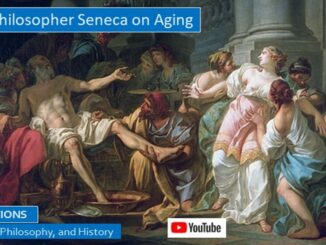
Seneca reminds us: “There is indeed a limit fixed to us,” “but none of us knows how near he is to this limit. Therefore, let us so order our minds as if we had come to the very end. Let us postpone nothing. Let us balance life’s account every day.” “Let us begin at once to live and count each separate day as a separate life.” What is important is “not how long you live, but how nobly you live. And often living nobly means that you cannot live long.” […]

Roman Stoic Philosopher Seneca on Aging, Retirement, and Death
Aging

Roman Stoic Philosopher Seneca on Old Age and Retirement

Seneca faces old age and death as only a Stoic could. “Old age is a time of life that is weary rather than crushed.” Nevertheless, I am thankful, “for age has not damaged my mind, though I feel its effects on my constitution. Only my vices” “have reached senility; my mind is strong,” “it is alert,” “it declares that old age is when it blooms.” “My mind bids me to consider how much this peace of mind and moderation of character I owe to wisdom and how much to my time of life; it bids me to distinguish carefully what I cannot do and what I do not want to do.” “There is only one chain that binds us to life, and that is the love of life.” […]

Major Roman Stoic Philosophers, My Favorite Maxims: Epictetus, Rufus, Seneca & Marcus Aurelius
Philosophy

Major Roman Stoic Philosophers, My Favorite Maxims: Epictetus, Rufus, Seneca & Marcus Aurelius

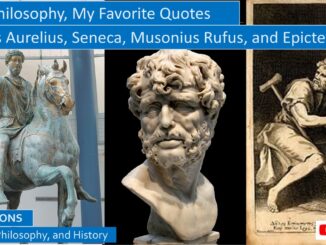
Many of the writings of the Stoics sound like passages from the Pauline Epistles. Indeed, Seneca was a contemporary of St Paul. There are epistles written between them, though nearly all scholars think they are spurious. Was St Paul inspired by the Stoic writings of Seneca? Although the Jewish rabbinic tradition was the primary source of inspiration for the Epistles and the Gospels, stoicism was an important secondary influence. In particular, stoicism deeply influenced the desert monastic tradition, which in turn influenced medieval monasticism. […]

The Cruel Roman Emperor Commodus, Son of the Good Stoic Emperor Marcus Aurelius
Greek and Roman History

The Cruel Roman Emperor Commodus, Son of the Good Stoic Emperor Marcus Aurelius

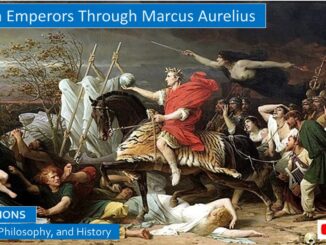
The wise stoic reign of Marcus Aurelius, beloved by all, was followed by the murderous reign of Commodus, hated and feared by all, who would be assassinated by his closest companions. The disastrously reckless cruelty of Commodus, and his neglectful reign, which nearly caused the disintegration of the Roman Empire, colors the opinion of both ancient and modern historians. What historians mention, but do not emphasize, are the similarities between the soldier Hadrian and Commodus. Both liked to fight in the ring as gladiators. Both decided to halt the Roman policy of expansion, seeking strategic withdrawal. And Marcus Aurelius was as wary of his adoptive grandfather Hadrian as he was of his wayward son Commodus. […]

History of Christian Persecutions, New Testament Through Marcus Aurelius
Greek and Roman History

History of Christian Persecutions, New Testament Through Marcus Aurelius

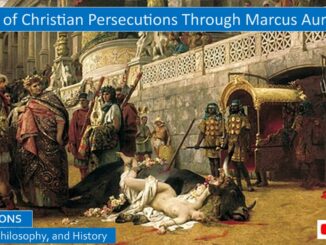
How widespread was the Christian persecution under the Roman Empire? Usually, it was a local affair, not until the reign of Diocletian was an empire-wide systematic persecution of Christians undertaken. The persecution under Nero was limited to Rome itself. The extent of the local persecution depended on the enthusiasm or cruelty of the local officials, many local officials had no enthusiasm for persecuting the local Christians, turning a blind eye. Overall, the number of persecutions was not huge, rarely were the Christian persecutions systematic, targeting all Christians. Indeed, the Christian martyrs in the twentieth century alone, mostly in Russia, dwarfed the number of Christian martyrs from the preceding nineteen centuries combined. […]

Roman Emperors before Marcus Aurelius
Greek and Roman History

Roman Emperors Before Marcus Aurelius

Hadrian’s peace policy was controversial, he abandoned Trajan’s conquests in Dacian Romania and Parthian Persia to concentrate on consolidating the Roman Empire. The problem was that the Roman Empire needed continual expansion, including war booty and slaves, to fund the empire and feed the growing populace of Rome. This policy certainly did not prevent future conflict with Parthian Persia.
Historians debate whether Hadrian’s defensive posture was wise. Were there prosperous provinces left to conquer on the frontiers? On the other hand, the successful expansion of the empire by the Byzantine Emperor Justinian several centuries later nearly bankrupted his Empire. […]