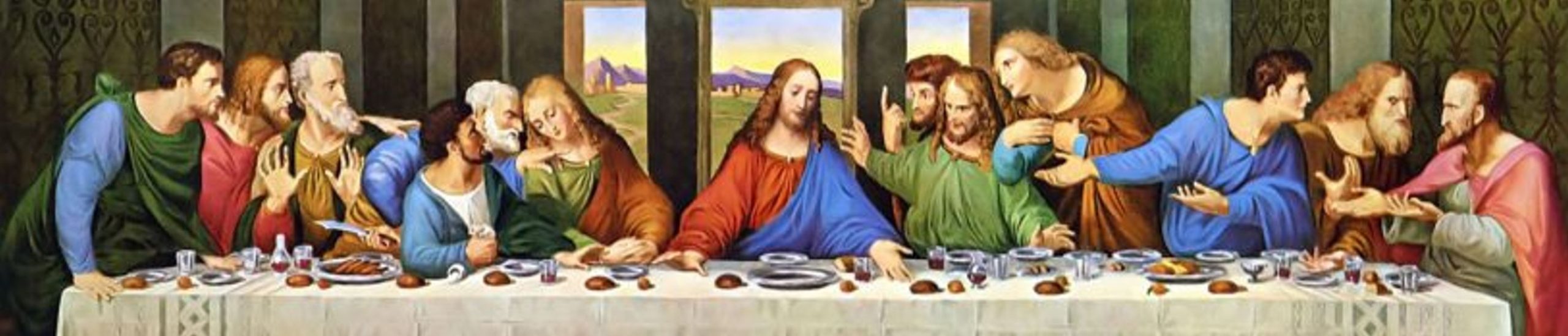
JRR Tolkien’s Lord of the Rings: How Was It Influenced by Nordic Mythology and Catholicism
History

JRR Tolkien’s Lord of the Rings: Was It Influenced by Nordic Mythology, Homer’s Iliad, and Catholicism?

What inspirations did JRR Tolkien draw from for his best-selling series The Lord of the Rings, and the Hobbit? Like his friend CS Lewis, Tolkien was an English Professor specializing in medieval and ancient literature and languages. When CS Lewis was contemplating whether to return to his Episcopalian roots, abandoning his youthful agnostic views, Tolkien argued that he should convert to Catholicism. CS Lewis resisted these pleas. IMHO, though CS Lewis was conducive to Catholicism, and may have even confessed his sins to a priest, he likely thought he would be more effective evangelizing through his books as an Episcopalian.
Both JRR Tolkien and CS Lewis fought in the trenches in France as British soldiers during World War I, they both lost many friends who fought beside them: they both experienced the horrors of war. Both were too old to serve in World War II, but this struggle against the evils of Naziism directly influenced CS Lewis’ Mere Christianity and Tolkien’s Lord of the Rings, both released shortly after the war. […]
Preparing the Way for Vatican II: CS Lewis' Mere Christianity
CS Lewis

Preparing the Way for Vatican II: CS Lewis’ Mere Christianity

CS Lewis did not wave the flag of ecumenicism, attending this conference or that on interfaith dialogues, but instead prepares the way, saying that what denominational creed you profess is less important than whether you truly believe the core Christian teaching of the two-fold Love of God and neighbor. This was the key change wrought by Vatican II, no longer did the Catholic Church believe you needed to be Catholic to be saved. Likewise, CS Lewis is against the notion that Catholics cannot be saved. […]

Facing the Nazi Menace: CS Lewis' Mere Christianity and Viktor Frankl's Man's Search for Meaning
CS Lewis

Facing the Nazi Menace: CS Lewis’ Mere Christianity and Viktor Frankl’s Man’s Search for Meaning

Mere Christianity was compiled from a series of radio addresses by CS Lewis explaining the tenets of Christianity which were broadcast during the dark days of World War II, when Londoners fled to the safety of the underground subway tunnels while Nazi bombers destroyed their homes above. We will reflect on the many instances where CS Lewis referred often to this monumental struggle, one of the rare political struggles that actually pitted the forces of good and evil against each other, in Mere Christianity. […]

Jimmy Carterm Inspirational Devotions SMALL
Bible Stories and Parables

Jimmy Carter Inspirational Daily Devotions: Bible Stories, Reflections on Historical Events

One of Bonhoeffer’s most famous books carried the title, The Cost of Discipleship. In it he condemns what he calls cheap grace. He insists one cannot follow Christ without full commitment, wherever that commitment might lead. In his case it led to a Nazi gallows.”

Dietrich Bonhoeffer and Karl Barth were leaders in the Confessing Church that resisted the Nazi infiltration and cooption of German Christianity, opposing the Nazi notion that Jesus wasn’t Jewish and that Christianity should condone the persecution of the Jews. […]

Current Events and History

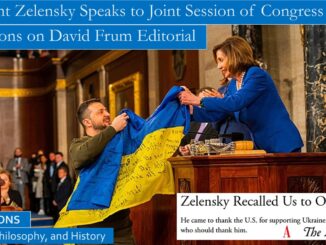
Ukrainian President Zelensky Speaks to Joint Session of Congress, Reflections on David Frum Editorial in Atlantic Magazine

David Frum writes, “Zelensky came to Washington to speak for his nation. He came to Washington to ask for assistance. But above all, he came to Washington to recall Americans to themselves. He came to say, My embattled people believe in you. Embedded in his words of trust was a challenge: If we believe in you, perhaps you can again believe in yourselves?” […]

History

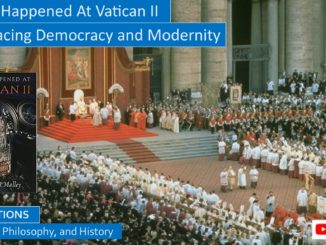
What Happened at Vatican II, Embracing Democracy and Modernity

Pope Benedict once said that both the supporters and opponents of the Second Vatican Council have one characteristic in common, and that is, most of them have never read the decrees or the history of Vatican II and are ignorant of the actual teachings of the council. His solution was to draft the Catholic Catechism, but unfortunately, nobody reads that either. […]

AntiSemitism

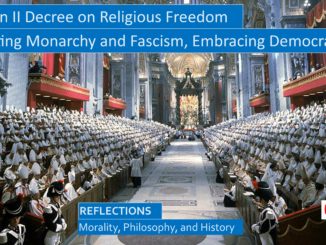
Vatican II Declaration on Freedom of Religion, Embracing Democracy, Rejecting Fascism

The Church Fathers of Vatican II believed that the Catholic guarantee of Religious Liberty was crucial for regaining the respect of many believers and the modern world.  History had evolved so that the Catholic Church was not on the side of truth regarding religious liberty.  From ancient times the Catholic Church was supported first by the Roman emperors starting with Constantine, and then the royalty of medieval Europe, but the absolute monarchies had all disappeared, giving way to dictators and republics, some of which were constitutional monarchies.  The Jacobism of the French Revolution and its grandchild communism were the enemies of the church, and the church supported fascism to combat communism.  World War II totally discredited fascism, now the Catholic Church saw democracy as the bulwark opposing communism, and religious liberty was a cornerstone for democracy. […]