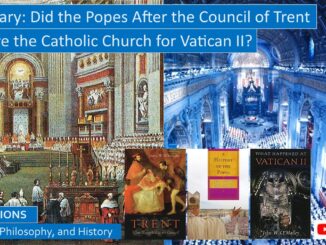
Summary of Papacies Between Trent and Vatican II. How Did These Popes Prepare the Way for Vatican II?
History

Summary of Papacies Between Trent and Vatican II. How Did These Popes Prepare the Way for Vatican II?

How did the Catholic Church survive the French Revolution, the conquests of Napoleon, and the Revolutions of 1848? Was the Second Vatican Council a continuation of Vatican I? Was Pope Leo XIII, who issued Rerum Novarum, the social justice encyclical that sympathized with the working man, a conservative or a […]

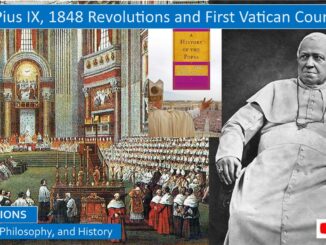
Pope Pius IX, 1848 Revolutions and First Vatican Council
History

Pope Pius IX, 1848 Revolutions and First Vatican Council

Why did Pope Pius IX call the council? John O’Malley notes: “Some people speculated he wanted it solemnly to confirm the Syllabus of Errors. He may have wanted it as a show of Catholic strength worldwide against the church’s enemies, especially in Italy.”
O’Malley continues: “Despite the broad agenda that was anticipated, the council dealt with only two items. The first was the relationship between revealed truth and the powers of human reason.” The council affirmed both the distinction and compatibility between them. With that resolved, the council planned to discuss “church-state relations and the role of the bishops, but with the encouragement of Pius it bypassed them and moved directly to consider” “papal primacy and papal infallibility.”
Papal primacy was not new; the Catholic Church had held this view for fifteen hundred years. But the pope and many bishops felt that the church needed to definitively state that the pope had full authority, not only over matters of faith and morals, but also over discipline and governance for the church worldwide, for both clergy and laity. […]
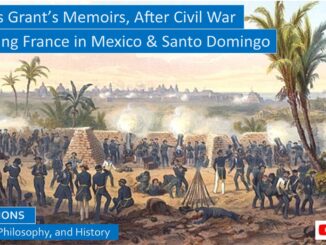
General Grant’s Memoirs, Civil War Diplomacy, Post-War Events in Mexico and Santo Domingo
Civil War Memories

General Grant’s Memoirs, Civil War Diplomacy, Post-War Events in Mexico and Santo Domingo

Grant assures us: “The cause of the Great War of the Rebellion against the United States will have to be attributed to slavery. For some years before the war began, it was a trite saying among some politicians,” including Lincoln in his House Divided Speech, “that a state half slave and half free cannot exist. All must become slave or all free, or the state will go down.” “Slavery was an institution that required unusual guarantees for its security wherever it existed.” Grant then criticizes the Fugitive Slave Law, in force before the Civil War, that compelled Northerners to help apprehend and return runaway slaves. […]