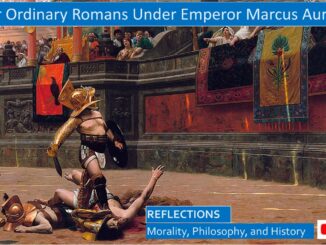
Ordinary Life for Romans Under Stoic Emperor Marcus Aurelius
History

Ordinary Life for Romans Under Stoic Emperor Marcus Aurelius

Professor Aldrete in his Wondrium lecture on the History of the Ancient World points out that the ancient historians and sources are silent on what life was like for the many farmers who labored in obscurity, that these ancient histories are really histories of political leaders and city dwellers. For every person who lived in the city in much of the ancient world, eight or nine lived on a family farm. The ratio differed around Rome, about a quarter of the people nearby lived in the city. Most people never traveled more than twenty miles from home, never saw a king, never read a book, or heard a philosopher speak. Most people living on farms did not even know the name of the Roman Emperor, and life went on as before no matter who was emperor. […]
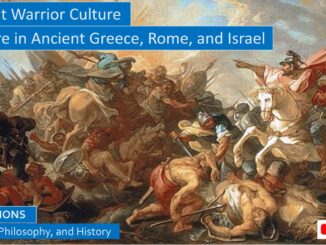

Ancient Warrior Culture - Ancient Greece, Rome, Israel
History

Ancient Warrior Societies, Blog 3, Warfare in the Old Testament

Warfare is mentioned over three hundred times in the Old Testament, swords four hundred times. Ancient Israel was caught in many of the ancient wars since it was in the cross-roads of trade routes between Mesopotamia and Egypt. Since Judah was mountainous, its armies relied heavily on infantry, but the Bible mentions that King Ahab of the Northern Kingdom had chariots, and that he was felled by arrow probably shot by a composite bow. Assyria and Babylon had cavalry archers on horseback, but not Egypt or Israel. An Israeli chariot had three horses pulling three men, a driver with a spear, an archer, and a shield bearer. We know from our Sunday School stores King David slew Goliath with a sling, but the ancient slings were not the puny toys we imagine, the sling in the ancient world was a deadly combat weapon. A skilled slinger could sling a rock over 120 miles per hour, faster than the fastest fast ball. […]

Ancient Warrior Culture - Ancient Greece, Rome, Israel
History

Ancient Warrior Societies, Blog 2, Ancient Greek and Roman Armies and Navies

The Greek innovation to ancient warfare was their hoplite warrior phalanx, a formation eight to ten rows of a hundred or more warriors, sometimes extending a quarter of a mile. The shields of the front row would interlock, and the entire formation would press upon the enemy, the soldiers would first throw their spears then jab with their swords from behind their shields, strictly maintaining their position. This required training and practice, the Athenians expected their nobles to drill during the year, the Spartans had a year-round military the practiced year-round. […]

Heraclitus, Pre-Socratic Philosopher, Inspiration for Stoics and Clement of Alexandria
Philosophy

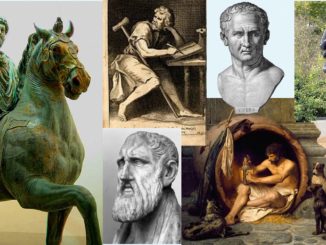
Heraclitus, Pre-Socratic Philosopher, Inspiration for Stoics and Church Fathers

What can we learn from reflecting on the surviving fragments of Heraclitus, the Pre-Socratic Philosopher? Many of his pithy sayings inspired the later Cynic and Stoic Philosophers, and the Church Fathers, including Clement of Alexandria and Hippolytus of Rome. These sayings by Heraclitus include: “God is day and night, winter […]

AntiSemitism

Our Reflections on Morality, Philosophy, and History: Ancient and Modern Classics

To a Stoic Philosopher, the question of Theodicy, or why God permits bad things to happen to good people, why God permits suffering, is simply absurd. The fact is, we do suffer, we will face injustices, we will suffer illnesses and death, and the rain falls on both the good man and the bad man. God will not shield us from suffering and injustice, but God will provide us with the strength to endure the challenges of this life. […]

Epicurean Philosophy

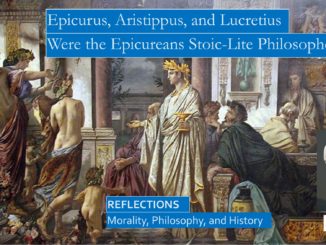
Epicurus, Aristippus, and Lucretius: History of Epicurean Philosophy

Was Epicureanism a cult? Or perhaps we should ask, was Epicureanism like a philosophical fraternity? One prominent scholar, AA Long, suggests that Epicurus’ school of philosophy was more a philosophical community centering on personal friendship than it was a formal school of philosophy. Many ancient philosophers wrote about the virtues of friendship, but the virtues of friendship are core to the Epicurean experience, and the Epicureans sought pleasure through their friendships. This community was egalitarian, it was one of the few in ancient world that admitted women and slaves, and in his letters, Epicurus expresses deep affection for his friends and followers. AA Long says this, “those who committed themselves to Epicurus we not so much students ‘reading for a course’ as men and women dedicated to a certain style of life.” […]

Command 9&10 Do Not Envy

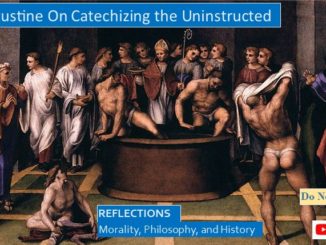
St Augustine on Catechizing the Uninstructed, Blog 1

In all his writings St Augustine reminds us that the core of our faith is the commands to Love God with all of our heart and with all of our soul and with all of our mind and with all of our strength, and to love our neighbor as ourselves.  In this work on catechesis St Augustine teaches that the vice that ruins love, the vice that is the enemy of love is envy, and that the mother of envy is pride.  This section is referenced in the Catholic Catechism teaching on the Commandment, Do Not Covet. […]

Marcus Aurelius

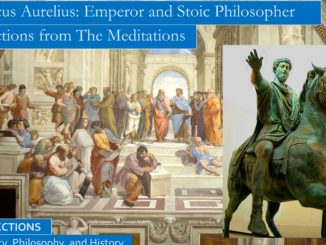
Marcus Aurelius Blog 5 Seeing life’s misfortunes through the eyes of our neighbor

Marcus Aurelius tells us that we should always remember that if men do not do right, we should assume that “they do so involuntarily and in ignorance. For as every soul is unwillingly deprived of the truth, so also is it unwillingly deprived of the power behaving as it should.”

We should “consider that we also do many things wrong, that we are merely men, that even when we refrain from certain faults, we still have the disposition to commit them, either through cowardice, concern about reputation, or some other mean motive.” […]