Pope Pius X, Promoting Piety, Rejecting Modernism
History

Pope Pius X, Promoting Piety, Rejecting Modernism

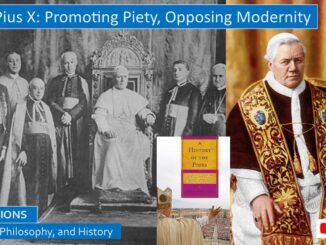
After the long and momentous papacy of Pope Leo XIII, the cardinals sought a candidate who would be a pastoral pope. They chose Guiseppe Sarto, who had spent his entire priestly life as a pastor, last serving as patriarch of Venice. He was from a family of modest means, and for nine years he served as a priest in a country parish. His formal education was meager, he studied at a seminary in Padua.
Our author John O’Malley explains: “Pope Pius X had never set foot outside Italy. He saw things in terms of black and white. While still Patriarch of Venice, he wrote to a friend: ‘When we speak of the Vicar of Christ, we must not quibble. We must obey. We must not evaluate his judgments or criticize his directions lest we do injury to Jesus Christ himself. Society is sick. The one hope, the one remedy, is the pope.’ The words ring like an Ultramontanist manifesto.” […]
Modern Catholic Popes

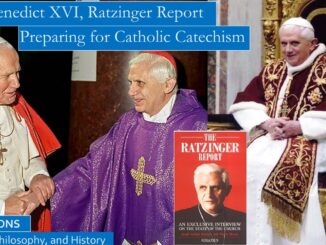
Ratzinger Report, by Future Pope Benedict XVI, Preparing for Catholic Catechism

Cardinal Ratzinger teaches us: “Every council that bears fruit must be followed by a wave of holiness. Thus it was after Trent, and it achieved its aim of real reform for this reason. Salvation for the Church comes from within her,” not solely “from the decrees of the hierarchy. Whether Vatican II and its results will be considered as a luminous period of Church history will depend upon all the Catholics who are called to give it life. As Pope John Paul II said in his commemoration of Charles Borromeo in Milan, ‘the Church of today does not need any new reformers, the Church needs new saints.’” […]

Modern Catholic Popes

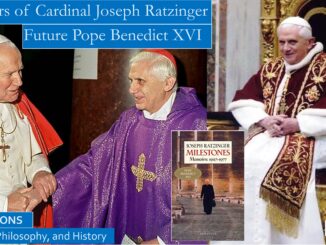
Milestones: Memoirs of Cardinal Joseph Ratzinger, Future Pope Benedict XVI

Archbishop Ratzinger teaches us that “this psalm from the wisdom tradition shows the straits of faith that comes from the absence of earthly success. When you stand on the side of God, you do not necessarily stand on the side of success.” “When the psalmist stands in before God, in the presence of God, he grasps the ultimate insignificance of material wealth and success and recognizes what is truly necessary and what brings salvation.” […]

History

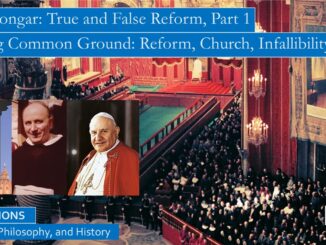
Yves Congar, True and False Reform, Part 1, Finding Common Ground

When Archbishop Angelo Roncalli, the future Pope John XXIII, reflected on this book, he asked, “A reform of the church? Is such a thing really possible?” Yves Congar reflects, What is the role of the church? Is the church the hierarchy in the Curia; or is the church the parishioners in the pews? What are the sacraments? What is the church’s definition of commonly misunderstood concepts, such as infallibility?
This book, along with help by the Holy Spirit, encouraged the pope to call for a church council, and helped set the tone for Vatican II. As Yves Congar teaches us, spiritual reform cannot be a revolution, false reform divides rather than unites. […]

History

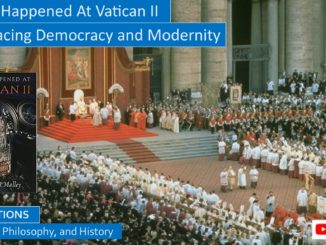
What Happened at Vatican II, Embracing Democracy and Modernity

Pope Benedict once said that both the supporters and opponents of the Second Vatican Council have one characteristic in common, and that is, most of them have never read the decrees or the history of Vatican II and are ignorant of the actual teachings of the council. His solution was to draft the Catholic Catechism, but unfortunately, nobody reads that either. […]