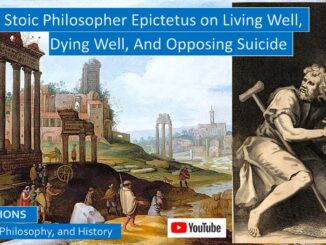
Epictetus, Eminent Roman Stoic Philosopher, on Living Well, Dying Well, and Opposing Suicide
Aging

Epictetus, Eminent Roman Stoic Philosopher, on Living Well, Dying Well, and Opposing Suicide

Is it wise to complain? Epictetus observes: “If someone dies young, he blames the gods because he is being taken before his time. If someone lingers on into extreme old age, he too blames the gods.” “Despite this, at the approach of death, he wants to stay alive; he sends for the doctors and begs him to do all he can.” “It is quite remarkable to see how people want neither to live nor to die.”
“Is health good and illness bad? No, man. What, then? Health managed well is good, but when badly managed, it is bad.”
Epictetus points out: “If you look at yourself in isolation, it is natural for you to live to an old age, to be rich, to be healthy. But if you look at yourself as a human being and as part of some whole, for the sake of that whole, it may be appropriate for you to be ill, or risk your life at sea, or be poor, or die young. Why get angry then?” “What is a human being? A part of a city made up of gods and human beings,” “a small copy of the universal city.” […]
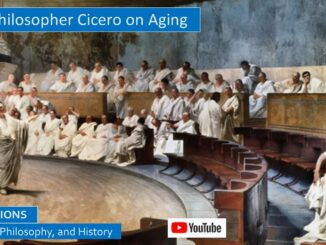
Roman Stoic Philosopher Cicero on Aging and Death
Philosophy

Roman Stoic Philosopher and Politician Cicero on Aging and Death

Cicero advises us: “Enjoy the blessing of strength while you have it, and have no regrets when it has gone, any more than young men should regret the end of boyhood, or those approaching middle age lament the passing of youth. Life’s course is invariable: nature has one path only, and you cannot travel along it more than once. Every stage of life has its own characteristics: boys are feeble, youths in their prime are aggressive, middle-aged men are dignified, while the elderly are mature. Each of these qualities is ordained by nature for harvesting in due season.”
Cicero continues: “Age must be overcome; its faults need vigilant resistance. We must combat them as we should fight a disease: following a fixed regime, exercising in moderation, and consuming enough food and drink to strengthen” but not too much. “The mind and spirit need even more attention than the body, for old age easily extinguishes them, like lamps” with too little oil. […]

Apeleius Golden Ass
Literature and Myths

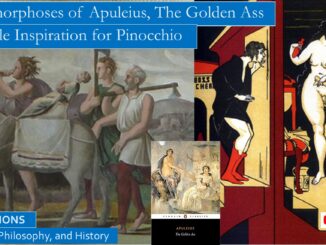
Metamorphosis of Apuleius, the Golden Ass, Possible Inspiration for Pinocchio

The basic plot of the book is our young man Lucius spies a witch who has learned to transform herself into various types of birds. When she is gone, he tries out the same potions, but by grabbing the wrong flask, he is turned into a donkey, not a talking donkey, but a braying donkey who has kept his human intelligence and human tastes. Though there are scattered penitential regrets, mostly our donkey is able to spy on the crimes and indiscretions of both robbers and cheating lovers to provide the reader with many titillating tales. In the final chapter, the goddess Isis appears to him in a dream, telling him what he needs to do to be transformed back into a human. […]

Erasmus In Praise of Folly
Catholic Middle Ages and Beyond

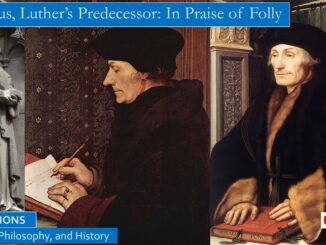
Erasmus, Luther’s Predecessor, The Praise of Folly

Folly reminds us of the tension between the vulgar and the devout. “The pious, since they aim primarily at what is almost alien to the crass senses, are numbed and stunned by the sensual. In contrast, the ordinary person gravitates towards them.” Thus, many negligent people value bodily sensations such as “sex, love of food, sleep, anger, pride, and envy. The pious wage a constant war against these urges, whereas the vulgar crowd considers that without them life has no real existence.” […]