
Cicero on Friendship and Virtue
Philosophy

Roman Stoic Philosopher Cicero On Friendship and Virtue

Cicero advises us: “The first and sacred law of friendship: Seek only good from friends, do only good for the sake of friends, and don’t wait to be asked! Be always attentive! Banish hesitation! Be ready to give advice freely! Take seriously the good advice of friends. Be ready to offer it openly, even forcefully, if the occasion demands, and also be ready to follow when it has been offered.”
In contrast, Antisthenes, the first Cynic philosopher who studied under Socrates, advises us: “Pay attention to your enemies, for they are the first to notice your faults.” Often, friends are reluctant to tell us what we need to know, preferring to tell us what they think we want to hear. […]


Roman Stoic Philosopher Cicero on Aging and Death
Philosophy

Roman Stoic Philosopher and Politician Cicero on Aging and Death

Cicero advises us: “Enjoy the blessing of strength while you have it, and have no regrets when it has gone, any more than young men should regret the end of boyhood, or those approaching middle age lament the passing of youth. Life’s course is invariable: nature has one path only, and you cannot travel along it more than once. Every stage of life has its own characteristics: boys are feeble, youths in their prime are aggressive, middle-aged men are dignified, while the elderly are mature. Each of these qualities is ordained by nature for harvesting in due season.”
Cicero continues: “Age must be overcome; its faults need vigilant resistance. We must combat them as we should fight a disease: following a fixed regime, exercising in moderation, and consuming enough food and drink to strengthen” but not too much. “The mind and spirit need even more attention than the body, for old age easily extinguishes them, like lamps” with too little oil. […]

Roman Emperors before Marcus Aurelius
Greek and Roman History

Roman Emperors Before Marcus Aurelius

Hadrian’s peace policy was controversial, he abandoned Trajan’s conquests in Dacian Romania and Parthian Persia to concentrate on consolidating the Roman Empire. The problem was that the Roman Empire needed continual expansion, including war booty and slaves, to fund the empire and feed the growing populace of Rome. This policy certainly did not prevent future conflict with Parthian Persia.
Historians debate whether Hadrian’s defensive posture was wise. Were there prosperous provinces left to conquer on the frontiers? On the other hand, the successful expansion of the empire by the Byzantine Emperor Justinian several centuries later nearly bankrupted his Empire. […]

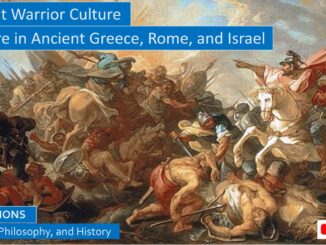
Ancient Warrior Culture - Ancient Greece, Rome, Israel
History

Ancient Warrior Societies, Blog 3, Warfare in the Old Testament

Warfare is mentioned over three hundred times in the Old Testament, swords four hundred times. Ancient Israel was caught in many of the ancient wars since it was in the cross-roads of trade routes between Mesopotamia and Egypt. Since Judah was mountainous, its armies relied heavily on infantry, but the Bible mentions that King Ahab of the Northern Kingdom had chariots, and that he was felled by arrow probably shot by a composite bow. Assyria and Babylon had cavalry archers on horseback, but not Egypt or Israel. An Israeli chariot had three horses pulling three men, a driver with a spear, an archer, and a shield bearer. We know from our Sunday School stores King David slew Goliath with a sling, but the ancient slings were not the puny toys we imagine, the sling in the ancient world was a deadly combat weapon. A skilled slinger could sling a rock over 120 miles per hour, faster than the fastest fast ball. […]

Ancient Warrior Culture - Ancient Greece, Rome, Israel
History

Ancient Warrior Societies, Blog 2, Ancient Greek and Roman Armies and Navies

The Greek innovation to ancient warfare was their hoplite warrior phalanx, a formation eight to ten rows of a hundred or more warriors, sometimes extending a quarter of a mile. The shields of the front row would interlock, and the entire formation would press upon the enemy, the soldiers would first throw their spears then jab with their swords from behind their shields, strictly maintaining their position. This required training and practice, the Athenians expected their nobles to drill during the year, the Spartans had a year-round military the practiced year-round. […]