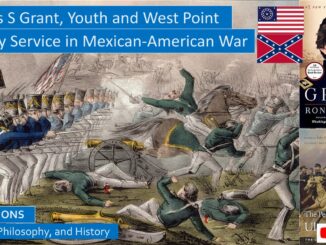
Early Life and Career of Ulysses S Grant Through His Service in the Mexican American War
Civil War Memories

Early Life and Career of Ulysses S Grant Through His Service in the Mexican American War

What was young Ulysses like? Chernow says that in his youth, Ulysses “seemed forgettable and colorless,” was not wayward or rambunctious or mischievous. “Like his mother, he was self-contained, as if he had trained his face to mask emotion and keep his inner life secret. Like Hannah, he was uncommonly even-tempered.” Unlike many great men of history, Ulysses in his youth had no vision of a great future and was prepared to live his life in obscurity. He was underestimated by many who met him.
Chernow describes traits that would serve him well later in life. “Never one to initiate a fight, he refused to back down when bullied. He was roused to fury if sadistic boys tormented an innocent child or a defenseless horse, and small boys embraced him as their steadfast protector.”
Ulysses was born with a love for horses. Chernow notes: “He liked to ride without a saddle or stirrups, sitting astride a blanket on the horse’s back, and he was so expert at handling horses that he began riding at age five. He became known for breaking in wild horses for local farmers.” “He tamed even the most refractory horses through a fine sensitivity to their nature rather than by his physical prowess.” […]
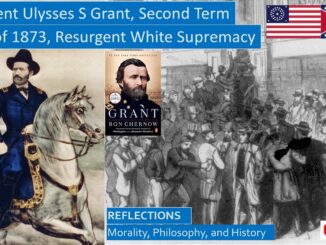
President Ulysses S Grant, White Supremacy Triumphs, and Gilded Age Corruption During his Second Term
Civil War and Reconstruction

President Ulysses S Grant, White Supremacy Triumphs, and Gilded Age Corruption During his Second Term

Why was President Grant easily reelected to second term, when there were so many problems faced in his first term? Why did the Liberal Republican Party become a third party? Was it truly liberal? Why did the Union Army fight several battles in Louisiana after the Civil War? How did […]

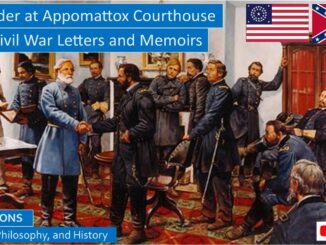
Surrender at Appomattox Courthouse, Ending the American Civil War
Civil War Memories

Surrender at Appomattox Courthouse, Ending the American Civil War

Robert E Lee ceremoniously offered his sword, but Grant refused it. Grant wrote out the terms, which paroled the Confederates on the condition that they “would not take arms against the Government of the United States.” “The arms, artillery and public property are to be parked and stacked.” “This will not embrace the side-arms of the officers, nor their private horses or baggage. This done, each officer and man will be allowed to return to their homes, not to be disturbed by the United States authority as long as they observe their paroles and the laws in force where they may reside.”
Grant recalls that when General Lee “read over that part of the terms about side arms, horses, and private property of the officers, he remarked, with some feeling, I thought, that this would have a happy effect upon his army.” […]

General Longstreet and Reconstruction
Civil Rights

Terror During Reconstruction, White League Confronts General Longstreet and Union Army

We will tell the stories of General Longstreet and the Union Major Merrill. General James Longstreet, a former Confederate general who had become a pariah in the South when he changed his party affiliation to Lincoln’s Republican Party, tried to prevent the insurrection in New Orleans. For his second posting during Reconstruction, Major Merrill attempted to reverse the insurrection of parishes on the outskirts of New Orleans. […]