AntiSemitism

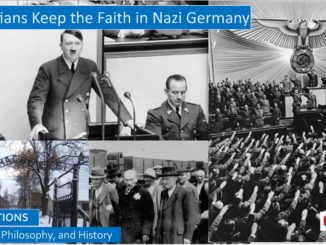
Christians Under Hitler’s German Nazi Regime

How could most Christians either tolerate or support the totalitarian Nazi regime of Hitler?  We cannot help but ask that question because we see bulging eyes of the skeletal concentration camp victims looking up in those black and white photographs, but we must realize that nobody in the prewar years could have predicted that the concentration camps would come to define Nazism.  In the prewar years many saw a reawakened national German pride and family values after the humiliation imposed by the Treaty of Versailles that ended World War I. […]

AntiSemitism

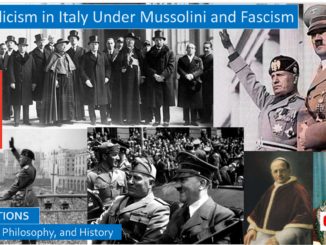
Mussolini’s Fascist Regime and the Catholic Church

Although Mussolini’s totalitarian regime was brutal, and although Mussolini was not a practicing Catholic himself, he did cooperate with the Pope and the Catholic Church.  Mussolini did not enact Nazi style anti-Semitic race laws until he fell under the spell of Hitler after 1938.  Until then, the Catholics in the pews were not morally forced to choose between obeying the church and the state. […]

AntiSemitism

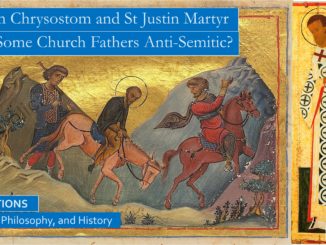
John Chrysostom, Justin Martyr, and the Church Fathers Preach Against the Judaizers and the Jews

John Chrysostom is the most strident of the early Church writers in his writings opposing the Judaizers where he warned his flock that Christians should not adopt Jewish customs and practices, that Christians needed to celebrate the Church festivals rather than the Jewish festivals, that Christians should not attend services at the synagogue. His work “Against the Judaizers” is so polemic that it is far more anti-Semitic than the writings of Barnabas and St Justin Martyr and many other church fathers, it is painful for us modern readers to read, we who remember the horrific events of the Holocaust. This work is not in the standard collection of the works of the Nicene and Anti-Nicene Fathers, but it was widely read in medieval times and afterward, and unfortunately was used to justify the European and Russian pogroms and persecutions against the Jews.[2]

One scholar who has pondered the problems posed polemic stands against the Judaizers by St John Chrysostom and also St Cyril is Robert Wilken. In this book “John Chrysostom and the Jews,” he explores the history of the early church to better understand the world of the early Church Fathers. We cannot totally excuse the errors in the teachings of the early Church Fathers, but neither can we blindly judge and condemn them for not knowing the lessons of the Holocaust. There is nothing wrong with reading the Church Fathers as they apply to our modern world, but particularly in this case we should also let the Church Fathers in their ancient historical context, we need to do both lest we have a distorted understanding of the history of our faith. […]

Facism

Vichy France, Blog 4, Christianity in Vichy France

Hitler shrewdly allowed the rump Vichy regime nominal autonomy in the third of France that was unoccupied by German troops. Marshal Petain and the Vichy regime had moral legitimacy in the early years of the war. Since the church teaches that the political authorities should be respected, the regime had the support of the elderly bishops throughout the war. The British were urging the French to fight on, from North Africa if necessary, but the Church Hierarchy felt that an attitude of repentance and acceptance was more appropriate. The humiliation of the German conquest was seen as an opportunity for moral and religious transformation. […]

Facism

Vichy France, Blog 3, The Tide Turns, Resistance and Collaboration

Now that Russia was again an enemy of Germany, the Communists in France faced greater pressure, causing more Communists to join the Resistance which actively opposed the Germans and the Vichy French, and also greater cooperation between Catholics and Communists in France that would last into the post-war years. Terrorism and assassinations of German officials increased, and the Vichy officials were drawn into the struggle against the Resistance, which was now a civil war.

Now the Vichy officials heard a new excuse when they urged the Germans to see them as partners rather than as conquered, the Germans were now far too busy on the Eastern front to attend to matters in Europe, the French would have to wait until the end of the war to negotiate a permanent peace.

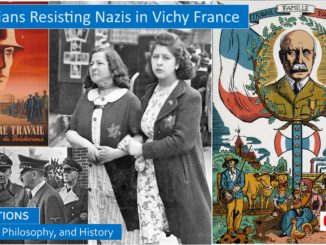
The German persecution of the Jews in France increased in 1942, Jews were required to wear yellow stars, and Himmler ordered that 100,000 Jews from all of France be deported to the Auschwitz death camps, foreign born Jews first. The Vichy officials offered token resistance.[3] This persecution extended to clergy who assisted the Jews, many French priests would be murdered in the Dachau concentration camp, many of the faithful would become martyrs in their defense of the Jews. One nun commented as she sent to the death camp in Ravensbruk, “I am leaving for Heaven.” […]

Facism

Vichy France, Blog 2, Collaborating with the Germans in the Early Years, 1940-1942

The war in France seemed over in 1940, with Germany in control of the continent, the French were asking, how would it be possible for England to fight back? Hitler was quite willing to accept a lenient armistice, lenient on his terms, Hitler did not want the French government to flee to continue the war from Algeria.

Marshall Petain announced over the radio, “With a heavy heart, I tell you that it is necessary to stop the fighting.” Charles de Gaulle remembered bitterly, “Not a single public figure raised his voice to condemn the armistice.” In hindsight we all know the Nazis lost the war, but in 1940 most French expected a final peace conference in a matter of months. Marshal Petain won the gratitude of most French who thought he had saved them from the abyss of another war in the trenches of France.

The Nazis occupied the northeast two-thirds of France, including Paris, but left the French Vichy regime to govern the rest France in relative autonomy. Soon the borders hardened between the occupied France and Vichy France. Although the Vichy leaders technically had jurisdiction over all of France, they were not even allowed to travel to Paris. Although some were eventually released, two million French POW’s were held in prison camps in Germany throughout the war, and the French had to pay most of their taxes to Germany as reparations to pay for the occupation forces. The German speaking provinces of Alsace-Lorraine were annexed by Germany. The French were eager to negotiate a permanent peace, but Hitler was not so eager. Again and again Hitler would tell the Vichy leaders that they needed to wait for the end of the war to end for a settlement. […]
Abortion

Vichy France Regime, Blog 1, Pro-Life, Pro-Catholic, and Fascist, and Dreyfus Affair

Was the reputation of the Catholic Church harmed by the collaboration of the Vichy regime? There is no single clear-cut answer to this question. The study of the Vichy regime is most valuable when used as a study on how Christians should live their lives under a secular and ungodly regime. Most of the bishops were compromised in their dealings with the Nazis and the Vichy regime, only one Vichy bishop spoke out against collaboration, many bishops were forced to resign at the war’s end. However, many Catholic clergy and laymen opposed the anti-Semitism of the war years. Communists and Catholics jointly fought against the Nazis in the French Resistance, and much pro-Catholic legislation introduced by the Vichy regime was retained after the war. We can be cautiously optimistic in our views, many Catholics and priests lived out their faith in difficult times, although many Catholics and priests collaborated with the Nazis. […]