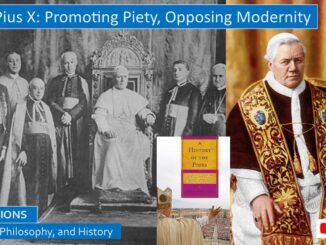
Pope Pius X, Promoting Piety, Rejecting Modernism
History

Pope Pius X, Promoting Piety, Rejecting Modernism

After the long and momentous papacy of Pope Leo XIII, the cardinals sought a candidate who would be a pastoral pope. They chose Guiseppe Sarto, who had spent his entire priestly life as a pastor, last serving as patriarch of Venice. He was from a family of modest means, and for nine years he served as a priest in a country parish. His formal education was meager, he studied at a seminary in Padua.
Our author John O’Malley explains: “Pope Pius X had never set foot outside Italy. He saw things in terms of black and white. While still Patriarch of Venice, he wrote to a friend: ‘When we speak of the Vicar of Christ, we must not quibble. We must obey. We must not evaluate his judgments or criticize his directions lest we do injury to Jesus Christ himself. Society is sick. The one hope, the one remedy, is the pope.’ The words ring like an Ultramontanist manifesto.” […]
AntiSemitism

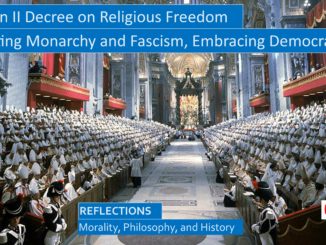
Vatican II Declaration on Freedom of Religion, Embracing Democracy, Rejecting Fascism

The Church Fathers of Vatican II believed that the Catholic guarantee of Religious Liberty was crucial for regaining the respect of many believers and the modern world.  History had evolved so that the Catholic Church was not on the side of truth regarding religious liberty.  From ancient times the Catholic Church was supported first by the Roman emperors starting with Constantine, and then the royalty of medieval Europe, but the absolute monarchies had all disappeared, giving way to dictators and republics, some of which were constitutional monarchies.  The Jacobism of the French Revolution and its grandchild communism were the enemies of the church, and the church supported fascism to combat communism.  World War II totally discredited fascism, now the Catholic Church saw democracy as the bulwark opposing communism, and religious liberty was a cornerstone for democracy. […]