
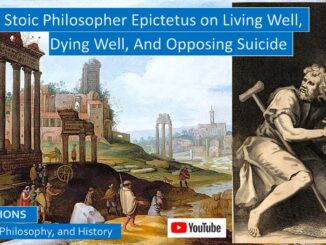
Epictetus, Eminent Roman Stoic Philosopher, on Living Well, Dying Well, and Opposing Suicide
Aging

Epictetus, Eminent Roman Stoic Philosopher, on Living Well, Dying Well, and Opposing Suicide

Is it wise to complain? Epictetus observes: “If someone dies young, he blames the gods because he is being taken before his time. If someone lingers on into extreme old age, he too blames the gods.” “Despite this, at the approach of death, he wants to stay alive; he sends for the doctors and begs him to do all he can.” “It is quite remarkable to see how people want neither to live nor to die.”
“Is health good and illness bad? No, man. What, then? Health managed well is good, but when badly managed, it is bad.”
Epictetus points out: “If you look at yourself in isolation, it is natural for you to live to an old age, to be rich, to be healthy. But if you look at yourself as a human being and as part of some whole, for the sake of that whole, it may be appropriate for you to be ill, or risk your life at sea, or be poor, or die young. Why get angry then?” “What is a human being? A part of a city made up of gods and human beings,” “a small copy of the universal city.” […]
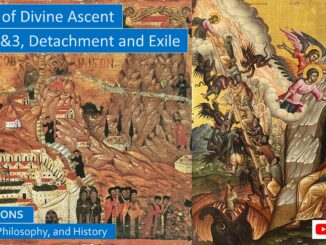
St John Climacus, Ladder of Divine Ascent, On Detachment, Exile, and Pilgrimage, Steps 2 and 3
Ladder of Divine Ascent

St John Climacus, Ladder of Divine Ascent, On Detachment, Exile, and Pilgrimage, Steps 2 and 3

St John Climacus wrote the Ladder of Divine Ascent as a handbook for monks living the monastic life, cut off from the world, in the isolation of the Egyptian desert monasteries, in a world before global communications where the monk could easily call his family on the monastery phone. In […]

Epictetus and Rufus

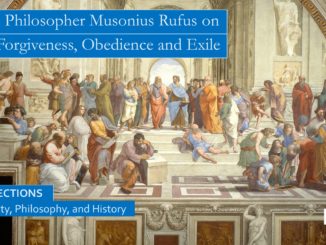
Stoic Philosopher Musonius Rufus on Exile

Rufus asks, like a good stoic, Why should the exile lament of his condition, why should he complain, how is he oppressed? Has he been exiled from the warmth of sun, has he been exiled from being refreshed by the rain, has he been excluded from the society of men? Rufus adds that in exile we may associate with our friends, our true friends, those friends “who would never betray or abandon us,” but those who shun us are not true friends, we are better off without those who are not truly friends. The most important question Rufus asks is, “How can exile be an obstacle to the . . . acquisition of virtue, when no one was ever hindered from the knowledge and practice of what is needful because of exile?” Rufus dismisses those who insist that exiles are the worse off when they also lose their freedom of speech. Nonsense, Rufus says, for you never truly lose your freedom of speech, for nobody can ever take away your freedom of thought, and if you do not feel free to speak out against injustice or impiety, you are not limited by lack of freedom, you are reined back by FEAR. To the truly courageous who insist on speaking out, the truly courageous who fear neither pain nor punishment nor death, how can they lose their freedom? They are truly free.

We must truly be thankful of all our fortunes and misfortunes, for neither keeps us from seeking virtue, and both can aid us in our journey towards greater virtue, towards salvation, towards the working out of our salvation, for what else does working out our salvation mean, if it does not mean that we work out our salvation through both our blessings and our sufferings? […]