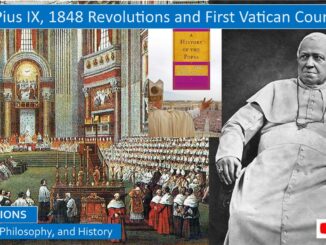
Pope Pius IX, 1848 Revolutions and First Vatican Council
Why did Pope Pius IX call the council? John O’Malley notes: “Some people speculated he wanted it solemnly to confirm the Syllabus of Errors. He may have wanted it as a show of Catholic strength worldwide against the church’s enemies, especially in Italy.”
O’Malley continues: “Despite the broad agenda that was anticipated, the council dealt with only two items. The first was the relationship between revealed truth and the powers of human reason.” The council affirmed both the distinction and compatibility between them. With that resolved, the council planned to discuss “church-state relations and the role of the bishops, but with the encouragement of Pius it bypassed them and moved directly to consider” “papal primacy and papal infallibility.”
Papal primacy was not new; the Catholic Church had held this view for fifteen hundred years. But the pope and many bishops felt that the church needed to definitively state that the pope had full authority, not only over matters of faith and morals, but also over discipline and governance for the church worldwide, for both clergy and laity. […]