Book Reviews and Miscellaneous

My Favorite Reflections on Morality, Philosophy, and History

Scholars, like most everyone else, are social creatures, and are eager to please their teachers. This means they usually repeat the narratives they have been taught. Additionally, professors are often so hyper-specialized that they overlook connections to other fields. And, as Professor Steven Pinker noted, back in the day, professors dared not study consciousness until they attained tenure.
Is there anything new under the sun? What I hope to find is someone from the past who confirms my insights, because original insights are most valuable when they are old truths long forgotten, or connections are overlooked because prior generations were blind to how current events affected their views. Even when there is no direct confirmation, I sometimes find reflections from past generations that indirectly confirm, or at least do not disprove my perspectives.
For me, creativity is not a problem, so I prefer to include quotes from ancient and modern authors, to encourage my listeners to read them on their own. Why restate aphorisms in my own words when they are so inspiring when originally uttered? The eastern Church Fathers did not see a need to reword inherited ancient teachings, so why should I? […]
Protestantism, Catholicism, Orthodoxy, and Judaism: Which Is True
christianity

Protestantism, Catholicism, Orthodoxy, and Judaism: Which Is True?

We agree with CS Lewis when, in his Preface to Mere Christianity, he states that “the reader should be warned that I offer no help to anyone who is hesitating between two Christian denominations. You will not learn from me whether you ought to become an Anglican, a Methodist, a Presbyterian, or a Roman Catholic.” CS Lewis compares his Mere Christianity to a central hall opening up to many rooms, representative of the various denominations, saying that this hall is a place to wait while you try the different doors.
CS Lewis continues: “There is no mystery of my own position. I am a very ordinary layman of the Church of England, not especially high, nor especially low, nor especially anything else.” […]

Joys of Successful Aging, by Evangelical George Sweeting, Moody Bible Institute
Aging

Joys of Successful Aging, by Evangelical George Sweeting, Moody Bible Institute

George Sweeting writes: “Age adds maturity and richness to life. Age smooths the rough edges of life and adds gentleness and compassion. They say: ‘The older the violin, the sweeter the music.’ Some speak of seniors as ancient, faded, frail, shriveled, senile, withered, wrinkled, and worthless!” I prefer to say seniors are “experienced, dependable, mature, patient, seasoned, steady, wise, tested, survivor, and veteran!” […]

JRR Tolkien’s Lord of the Rings: How Was It Influenced by Nordic Mythology and Catholicism
History

JRR Tolkien’s Lord of the Rings: Was It Influenced by Nordic Mythology, Homer’s Iliad, and Catholicism?

What inspirations did JRR Tolkien draw from for his best-selling series The Lord of the Rings, and the Hobbit? Like his friend CS Lewis, Tolkien was an English Professor specializing in medieval and ancient literature and languages. When CS Lewis was contemplating whether to return to his Episcopalian roots, abandoning his youthful agnostic views, Tolkien argued that he should convert to Catholicism. CS Lewis resisted these pleas. IMHO, though CS Lewis was conducive to Catholicism, and may have even confessed his sins to a priest, he likely thought he would be more effective evangelizing through his books as an Episcopalian.
Both JRR Tolkien and CS Lewis fought in the trenches in France as British soldiers during World War I, they both lost many friends who fought beside them: they both experienced the horrors of war. Both were too old to serve in World War II, but this struggle against the evils of Naziism directly influenced CS Lewis’ Mere Christianity and Tolkien’s Lord of the Rings, both released shortly after the war. […]

St John Climacus, Ladder of Divine Ascent Steps 16&17 Avarice and NonPossessiveness
Ladder of Divine Ascent

St John Climacus, Ladder of Divine Ascent, On Avarice and Non-Possessiveness, Steps 16 & 17

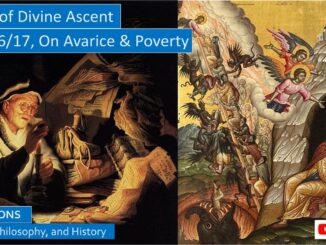
Avarice is the worst kind of drought and famine, for it is drought and famine in the midst of plenty. A Jewish story tells of a man taken on a tour of Hell, where he sees a huge banquet hall, with long tables lined with souls, each one ogling their plate heaped with roast beef, sausage, breads, fruits and pies. This sumptuous meal tormented each one, all were starving, for they had no elbows to feed themselves. Then he was shown the banquet hall in Heaven, same type of banquet hall, same meats, breads, fruits and pies, but here the mood was joyous. Like those souls in Hell, they had no elbows, but they were joyous because they were feeding each other. […]

St John Climacus on Love, Lust, and Marriage: Ladder of Divine Ascent, Step 15, on Purity & Chastity
Ladder of Divine Ascent

St John Climacus on Love, Lust, and Marriage: Ladder of Divine Ascent, Step 15, on Purity and Chastity

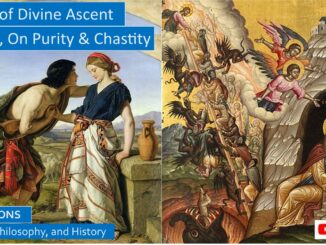
Laymen often wonder: How can those who are married be chaste? In his commentary on the Ladder of Divine Ascent, Father Vassilios Papavassiliou teaches us that “people tend to think of chastity in purely sexual terms as the virtue opposed to sexual depravity.” But just as the word concupiscence has a deeper meaning for Catholics, chastity has a deeper meaning for Orthodox Christians. “In the Orthodox marriage service, we pray that the newlyweds may live in chastity. But yet in the same service, we pray numerous times that they may have honorable children. How can a couple live in” “sexual purity, and yet have children?”
The simple answer is that chastity and sexual purity are not exactly the same. He points out that “a fuller, more accurate translation of the Greek term sphrosini is whole-mindedness, or harmony between the flesh and the spirit.” Father Vassilios teaches us that in the Church “the intimate union between husband and wife is a living symbol of the union between Christ, the Bridegroom, and the Church, His Bride,” which is why intimacy should be experienced by a man and his wife. […]

Summary of Mere Christianity, WWII Ecumenical Broadcast: Morality, Not Polemics
CS Lewis

Summary of CS Lewis’ Mere Christianity, WWII Ecumenical Broadcast: Morality Not Polemics

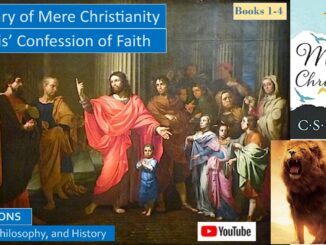
Many scholars speculate on whether CS Lewis was inspired by the writings of Richard Baxter, a Puritan and prolific author who first coined the phrase “Mere Christianity.” Baxter lived during the intense religious struggle in the late 1600’s, a century after Henry VIII split from the Catholic Church to form the Anglican Church. Baxter was appointed to the royal chaplaincy, but he left his post after the passage of the Act of Uniformity in 1662, which required that all pastors exclusively use the Book of Common Prayer and be ordained as Anglican ministers. Baxter was reluctant to adopt a denomination, proclaiming that “I am a Christian, a MEER CHRISTIAN, of no other religion,” and “I am against all sects and dividing parties.” He did not want to identify either with Catholics, or Anglicans, or Presbyterians. […]

CS Lewis’ Mere Christianity: Forgiveness, Pride, and Envy. Can Pride Ever Be Good?
CS Lewis

CS Lewis’ Mere Christianity: Forgiveness, Pride, and Envy. Can Pride Ever Be Good?

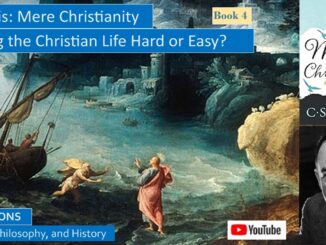
CS Lewis notes that in the middle of the Lord’s Prayer we pray: “Forgive us our sins as we forgive those who sin against us.” He observes: “There is no slightest suggestion that we are offered forgiveness on any other terms. It is made perfectly clear that if we do not forgive, we shall not be forgiven.”
Indeed, immediately after the Lord’s Prayer in Matthew, Jesus exhorts us: “For if you forgive men their trespasses, your heavenly Father also will forgive you; but if you do not forgive men their trespasses, neither will your Father forgive your trespasses.” […]

CS Lewis’ Mere Christianity: Reflections on Intimacy, Romance, Marriage, and Divorce
CS Lewis

CS Lewis’ Mere Christianity: Intimacy, Romance, Marriage, and Divorce

CS Lewis continues: “Being in love is a good thing, but it is not the best thing.” “You cannot make it the basis of a whole life. It is a noble feeling, but it is still a feeling.” But CS Lewis warns us that the initial excitement will not last, that “love in the second sense is not merely a feeling, but is a deep unity, maintained by the will and deliberately strengthened by habit, reinforced in Christian marriages by the grace which both partners ask, and receive, from God.” […]