Did Rome Fall, or Evolve to Barbarian Kingdoms? Sack of Rome, and Attila the Hun’s Invasions
Greek and Roman History

Did Rome Fall, or Evolve Into the Barbarian Kingdoms? Sacks of Rome, and Attila the Hun’s Invasions

Peter Brown contends: “The Roman Empire was not violently breached by barbarian “invasions.” Rather, between AD 200 and 400, the frontier itself changed. From being a defensive region, which kept Romans and barbarians apart, it had become, instead, an extensive middle ground, in which roman and barbarian societies were drawn together. And after AD 400, it was the barbarians and no longer the Romans who became the dominant partners in the middle ground.” Indeed, after AD 400 barbarian tribes served in the army of the Huns, and barbarians from most of the tribes, including the Huns, served in the Roman armies. […]
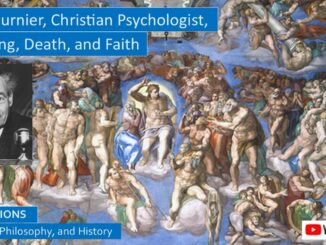
Classical Christian Psychologist Paul Tournier on Old Age, Death, and Faith
Aging

Classical Christian Psychologist Paul Tournier on Old Age, Death, and Faith

Tournier reminds us that we may experience many successes, but as we grow older, “success retreats, and escapes us, it is limited, unfulfilled.” “When one comes to the end, a man’s life is nothing much.” “Professional life is over, and it finishes unfinished. This is a prefiguration of death, in which the whole of life will finish it, too, being unfinished. That is the dramatic contradiction of death.” Quoting Robert Mehl: “An end, but not a fulfilment, that is the face of death.” […]

St Augustine’s On Christian Teaching and JD Vance, Order of Love
Politics

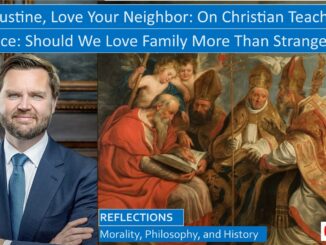
St Augustine’s On Christian Teaching and JD Vance, Order of Love

St Augustine clearly teaches us: “All people should be loved equally. But you cannot do good to all people equally, so you should take particular thought for those who, as if by lot, happen to be particularly close to you in terms of place, time, or any other circumstances.”
St Augustine explains further: “Suppose you have plenty of something which had to be given to someone in need but could not be given to two people, and you met two people,” you could flip a coin for who would receive it. But if one of them was a relative, Jesus would not object if you benefited him. In other words, if your children are starving, you need not share what little food you have with strangers.
Should we love everyone, even our enemies? Definitely, Christians are exhorted to love their enemies. As St Augustine teaches us: “We do not fear our enemies, for they do not take away from us what we love, but we pity them, for they hate us all the more because they are separated from the one we love,” since they are separated from God. […]

St John Chrysostom On Reading Scriptures, Preaching, and Chariot Races
Eastern Church Fathers

St John Chrysostom On Reading Scriptures, Preaching, and Chariot Races

“What are you saying, man? That attending to the Scriptures is not for you, since you are surrounded by a multitude of cares? Rather it is for you more than them. Monks do not need the help of the divine Scriptures as much as those who are involved in many occupations. The monks, who are released from the clamor of the marketplace and have fixed their huts in the wilderness, who own nothing in common with anyone, but practice wisdom in the calm of that quiet life, as if resting in a harbor, enjoy great security; but we, as if tossing in the midst of the sea, driven by a multitude of sins the continuous aid of the Scriptures.” […]

Summary of Mere Christianity, WWII Ecumenical Broadcast: Morality, Not Polemics
CS Lewis

Summary of CS Lewis’ Mere Christianity, WWII Ecumenical Broadcast: Morality Not Polemics

Many scholars speculate on whether CS Lewis was inspired by the writings of Richard Baxter, a Puritan and prolific author who first coined the phrase “Mere Christianity.” Baxter lived during the intense religious struggle in the late 1600’s, a century after Henry VIII split from the Catholic Church to form the Anglican Church. Baxter was appointed to the royal chaplaincy, but he left his post after the passage of the Act of Uniformity in 1662, which required that all pastors exclusively use the Book of Common Prayer and be ordained as Anglican ministers. Baxter was reluctant to adopt a denomination, proclaiming that “I am a Christian, a MEER CHRISTIAN, of no other religion,” and “I am against all sects and dividing parties.” He did not want to identify either with Catholics, or Anglicans, or Presbyterians. […]

CS Lewis’ Mere Christianity: Reflections on Intimacy, Romance, Marriage, and Divorce
CS Lewis

CS Lewis’ Mere Christianity: Intimacy, Romance, Marriage, and Divorce

CS Lewis continues: “Being in love is a good thing, but it is not the best thing.” “You cannot make it the basis of a whole life. It is a noble feeling, but it is still a feeling.” But CS Lewis warns us that the initial excitement will not last, that “love in the second sense is not merely a feeling, but is a deep unity, maintained by the will and deliberately strengthened by habit, reinforced in Christian marriages by the grace which both partners ask, and receive, from God.” […]

Faith, Hope, Charity, and Love in CS Lewis’ Mere Christianity: The Theological Virtues
CS Lewis

Faith, Hope, Charity, and Love in CS Lewis’ Mere Christianity: The Theological Virtues

CS Lewis teaches us, “Charity means Love in the Christian sense. But love, in the Christian sense, does not mean an emotion. It is a state not of the feelings but of the will; that state of the will which we have naturally about ourselves and must learn to have about other people.”
“Do not waste time bothering whether you ‘love’ your neighbor; act as if you did.” Be kind to your neighbor, and often you will like and love him more. But if they do not reciprocate, or are openly hostile, love them anyway, and help them if you can. We always find it easier to love, or like, those who are courteous towards us. […]

Mere Morality and the Cardinal Virtues in CS Lewis’ Mere Christianity: Prudence, Temperance, and Justice
CS Lewis

Mere Morality and the Cardinal Virtues in CS Lewis’ Mere Christianity: Prudence, Temperance, and Justice

CS Lewis has “two bits of evidence that the Somebody,” whom we worship as the Almighty God, truly exists. “One is the universe he made.” “The other bit of evidence is that Moral Law which He has put into our minds. And this is a better bit of evidence than the other because it is inside information.” In the Judeo-Christian traditions, “we conclude that the Being behind the universe is intensely interested in right conduct: in fair play, unselfishness, courage, good faith, honesty and truthfulness.” […]

Good Friday, Easter, and the Trinity SMALL CS Lewis Mere Christianity, the Chronciles of Narnia, and St Augustine
CS Lewis

Good Friday, Easter, and Trinity: CS Lewis’ Mere Christianity, Narnia, & St Augustine’s Confessions

How can we make sense of Jesus’ crucifixion on Good Friday and his resurrection on Easter Sunday? CS Lewis proclaims, “The central Christian belief is that Christ’s death has somehow put us right with God and given us a fresh start.” “We are told that Christ was killed for us, that His death has washed out our sins, and that by dying He disabled death itself. That is the formula. That is Christianity.” CS Lewis discusses how atonement erases the stain of original sin from mankind, but he avoids using these Catholic-sounding words. […]