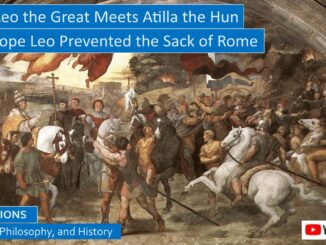
Pope Leo the Great, Confronting Attila the Hun, and His Role in Fourth Ecumenical Council of Chalcedon
Catholic Middle Ages and Beyond

Pope Leo the Great, Confronting Attila the Hun, and His Role in the Fourth Ecumenical Council of Chalcedon

As Pope Benedict XVI writes: “The times in which Pope Leo lived were very difficult: constant barbarian invasions, the gradual weakening of imperial authority in the West, and the long, drawn-out social crisis forced the Bishop of Rome” “to play an important role in both civil and political events.”
“In a period of profound crisis, Leo the Great knew how to make himself close to the people and the faithful with his pastoral action and his preaching. He enlivened charity in a Rome tried by famines, an influx of refugees, injustice, and poverty. He opposed pagan superstitions and actions of Manichaean groups. He associated the liturgy with the daily life of Christians.” […]
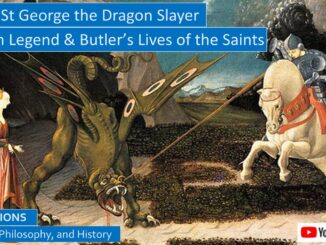
St George the Dragon Slayer, From the Golden Legend and Butler’s Lives of the Saints
Lives of Saints

St George the Dragon Slayer, From the Golden Legend and Butler’s Lives of the Saints

Dacian then sought to trick St George with persuasion, and our saint played along. St George was led into a pagan temple where the people expected he would sacrifice to the gods. “But instead of sacrificing, St George knelt and prayed for the Lord to destroy the temple and all its idols, and destroy it so completely that, for the glory of God and the conversion of the people, absolutely nothing was to be left. At once fire fell from heaven and burnt the temple, its idols and priests, to a cinder, and the earth gaped open and swallowed up the remains.” […]

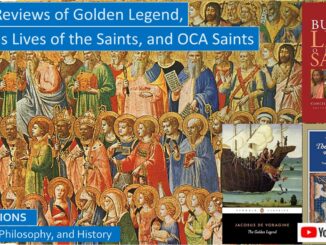
Book Reviews: Golden Legend, Butler’s, OCA, and Pope Benedict XVI’s Lives of Saints
Book Reviews and Miscellaneous

Book Reviews: Golden Legend, Butler’s, OCA, and Pope Benedict XVI’s Lives of Saints

The compiler of the Golden Legend was the Dominican friar Jacobus de Voragine. The Dominicans historically have been concerned about historical accuracy to guard the faith against heresy. He lists as his three primary sources the lives from Ecclesiastical History by Eusebius, bishop and advisor to Emperor Constantine; the Tripartite History by Cassiodorus; and the Scholastic History by Peter Comestor. In addition, he refers to more than 120 other sources. He was also influenced by earlier collections of lives of the saints by two other Dominican scholars. When his sources were apocryphal and not trustworthy, he points this out. When possible, he tries to reconcile dates and details, but is more concerned with the spiritual lessons than historical accuracy. […]