Pope Pius X, Promoting Piety, Rejecting Modernism
History

Pope Pius X, Promoting Piety, Rejecting Modernism

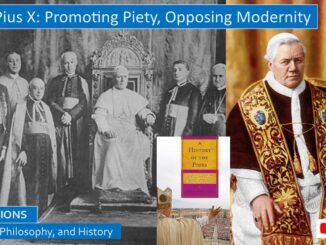
After the long and momentous papacy of Pope Leo XIII, the cardinals sought a candidate who would be a pastoral pope. They chose Guiseppe Sarto, who had spent his entire priestly life as a pastor, last serving as patriarch of Venice. He was from a family of modest means, and for nine years he served as a priest in a country parish. His formal education was meager, he studied at a seminary in Padua.
Our author John O’Malley explains: “Pope Pius X had never set foot outside Italy. He saw things in terms of black and white. While still Patriarch of Venice, he wrote to a friend: ‘When we speak of the Vicar of Christ, we must not quibble. We must obey. We must not evaluate his judgments or criticize his directions lest we do injury to Jesus Christ himself. Society is sick. The one hope, the one remedy, is the pope.’ The words ring like an Ultramontanist manifesto.” […]
Q & A on Topic: Why Did You Leave Your Religion?
Biblical Interpretation

Q & A on Topic: Why Did You Leave Your Religion?

To the ancients who lived in a warrior culture, Stoic philosophy is very appealing. The Stoics don’t ask the question: Why do bad things happen to good people? Instead, they admit that good and bad things happen to everyone, that the rain falls on both the bad and the good. Bad things happen to good people, that is part of life. The real question is: How can God help us endure and prevail over our suffering? […]

Morality

St Augustine’s Confessions: Mother Monica, Concubine, Marriage, and Philosophy, Books 6 & 7

The Confessions were written soon after St Augustine was drafted to be the co-bishop of Hippo, near Carthage. The Confessions are not only a confession of faith and a confession of sin and sinful longings, but also a mirror into his soul, exploring his innermost motivations. The style is unique, Bishop Augustine addresses his Confessions as a prayer to God, addressing God directly, imbedding verses of Scripture and the Psalms directly into his Confessions as he writes these words on his soul. […]

Modern Catholic Popes

Ratzinger Report, by Future Pope Benedict XVI, Preparing for Catholic Catechism

Cardinal Ratzinger teaches us: “Every council that bears fruit must be followed by a wave of holiness. Thus it was after Trent, and it achieved its aim of real reform for this reason. Salvation for the Church comes from within her,” not solely “from the decrees of the hierarchy. Whether Vatican II and its results will be considered as a luminous period of Church history will depend upon all the Catholics who are called to give it life. As Pope John Paul II said in his commemoration of Charles Borromeo in Milan, ‘the Church of today does not need any new reformers, the Church needs new saints.’” […]

Modern Catholic Popes

Milestones: Memoirs of Cardinal Joseph Ratzinger, Future Pope Benedict XVI

Archbishop Ratzinger teaches us that “this psalm from the wisdom tradition shows the straits of faith that comes from the absence of earthly success. When you stand on the side of God, you do not necessarily stand on the side of success.” “When the psalmist stands in before God, in the presence of God, he grasps the ultimate insignificance of material wealth and success and recognizes what is truly necessary and what brings salvation.” […]

Biblical Interpretation

Biblical Interpretation in the Catholic Church, the 1994 Pontifical Biblical Commission Decree

Historically, the Catholic Church has defended itself from attacks, both real and imagined, from enemies of the faith, and this defensiveness also extended to Biblical studies. The twentieth century saw a relaxing of this defensiveness, culminating in the decree Dei Verbum pronounced by Vatican II, encouraging Catholic scholars to use more modern methods of interpreting the Scriptures, under the guidance of the Vatican office, the Pontifical Biblical Commission. […]

Historical Jesus

Historical Jesus Blog 4, Views of Historical Jesus Scholars

We will not be talking about the Jesus of Meier because he respects the Tradition of the Church.  Witherington credits Meier’s work with “caution and careful, detailed argumentation.”  Unlike many other modern scholars, Meier does not dismiss the spiritual Gospel of John as a source of historical data about Jesus.  Like the other historical Jesus scholars, Meier uses criteria to sift through the Gospel material, but he does not use the criteria to discard material, and he uses the criteria more conservatively.  Most importantly, Meier sees the resurrection as a happening in the spiritual realm rather than the historical realm, but that this does not disprove the resurrection. It is still very real to the believer.  Like Johnson, he distinguishes between the historical Jesus and the real Jesus, the Jesus of faith, Jesus who is truly the Son of God. […]

Historical Jesus

Historical Jesus, Blog 2, Modern Search for Historical Jesus

What is the theological agenda for this third historical Jesus movement? Opposition to fundamentalism. They do not want the fundamentalists to monopolize the airwaves, so they shamelessly promote their views so they fit in thirty second sound bites. They value radical academic independence, and denigrate subservience to tradition, and have no fear for ignoring Scripture they personally do not judge is historical, and for elevating newly discovered gnostic writings over Scripture in their quest for the historical Jesus. Witherington quotes Funk as saying, “methodology is not an indifferent net – it catches what it intends to catch.” […]