Pope Leo the Great, Confronting Attila the Hun, and His Role in Fourth Ecumenical Council of Chalcedon
Catholic Middle Ages and Beyond

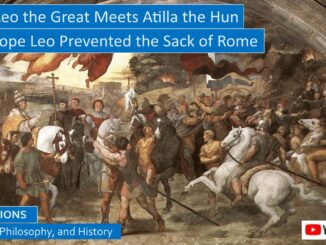
Pope Leo the Great, Confronting Attila the Hun, and His Role in the Fourth Ecumenical Council of Chalcedon

As Pope Benedict XVI writes: “The times in which Pope Leo lived were very difficult: constant barbarian invasions, the gradual weakening of imperial authority in the West, and the long, drawn-out social crisis forced the Bishop of Rome” “to play an important role in both civil and political events.”
“In a period of profound crisis, Leo the Great knew how to make himself close to the people and the faithful with his pastoral action and his preaching. He enlivened charity in a Rome tried by famines, an influx of refugees, injustice, and poverty. He opposed pagan superstitions and actions of Manichaean groups. He associated the liturgy with the daily life of Christians.” […]
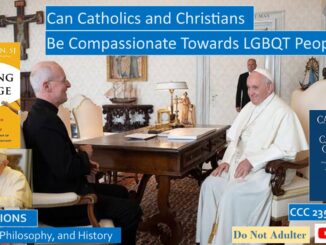
Building Bridges Between Church and LGBTQ Community
Catholic Catechism

The Church, the Catholic Catechism, and the LGBT Community

How should this two-fold Love of God and love of neighbor affect how we enforce moral laws in our faith and civil communities? When should these be enforced?

Simply put, in the Judeo-Christian tradition, they should be enforced so they increase in our hearts the two-fold Love of God and neighbor. This certainly means we should discourage sexual abuse and punish serious sexual abuse that is proven. Certainly, it means we should seek to be compassionate rather than cruel, because compassion is loving, while cruelty is hateful. […]

Modern Catholic Popes

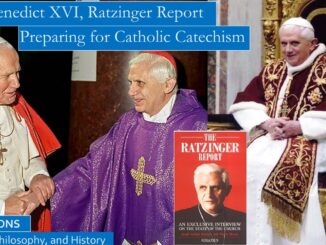
Ratzinger Report, by Future Pope Benedict XVI, Preparing for Catholic Catechism

Cardinal Ratzinger teaches us: “Every council that bears fruit must be followed by a wave of holiness. Thus it was after Trent, and it achieved its aim of real reform for this reason. Salvation for the Church comes from within her,” not solely “from the decrees of the hierarchy. Whether Vatican II and its results will be considered as a luminous period of Church history will depend upon all the Catholics who are called to give it life. As Pope John Paul II said in his commemoration of Charles Borromeo in Milan, ‘the Church of today does not need any new reformers, the Church needs new saints.’” […]

Modern Catholic Popes

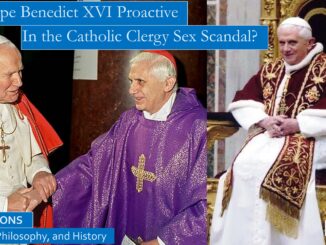
Was Pope Benedict XVI proactive in the pedophile priest sex scandal?

Penance is what Christians do; Christians repent. Unfortunately, many secular media interpreted these gestures by Pope Benedict as an admission of personal guilt.
During this time Cardinal Ratzinger confessed, “The greatest persecution of the Church comes not from her enemies without but arises from sin within the Church.” “The Church has a deep need to relearn penance, to accept purification, to learn forgiveness on the one hand, but also the need for justice.”
The media can be unfair at times. Pope Benedict XVI said that “we must be grateful for every disclosure. The truth, combined with love rightly understood, is primary. The media could not have reported these incidents had there not been evil in the Church herself.” […]

Modern Catholic Popes

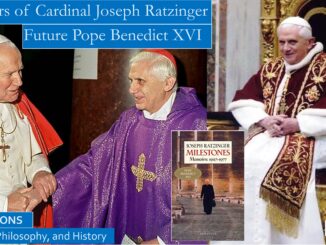
Milestones: Memoirs of Cardinal Joseph Ratzinger, Future Pope Benedict XVI

Archbishop Ratzinger teaches us that “this psalm from the wisdom tradition shows the straits of faith that comes from the absence of earthly success. When you stand on the side of God, you do not necessarily stand on the side of success.” “When the psalmist stands in before God, in the presence of God, he grasps the ultimate insignificance of material wealth and success and recognizes what is truly necessary and what brings salvation.” […]

History

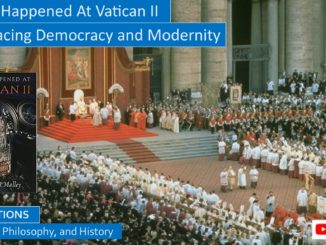
What Happened at Vatican II, Embracing Democracy and Modernity

Pope Benedict once said that both the supporters and opponents of the Second Vatican Council have one characteristic in common, and that is, most of them have never read the decrees or the history of Vatican II and are ignorant of the actual teachings of the council. His solution was to draft the Catholic Catechism, but unfortunately, nobody reads that either. […]

AntiSemitism

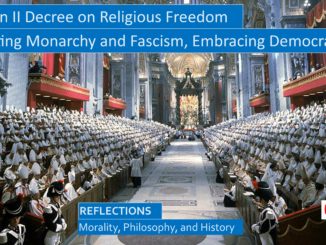
Vatican II Declaration on Freedom of Religion, Embracing Democracy, Rejecting Fascism

The Church Fathers of Vatican II believed that the Catholic guarantee of Religious Liberty was crucial for regaining the respect of many believers and the modern world.  History had evolved so that the Catholic Church was not on the side of truth regarding religious liberty.  From ancient times the Catholic Church was supported first by the Roman emperors starting with Constantine, and then the royalty of medieval Europe, but the absolute monarchies had all disappeared, giving way to dictators and republics, some of which were constitutional monarchies.  The Jacobism of the French Revolution and its grandchild communism were the enemies of the church, and the church supported fascism to combat communism.  World War II totally discredited fascism, now the Catholic Church saw democracy as the bulwark opposing communism, and religious liberty was a cornerstone for democracy. […]

Biblical Interpretation

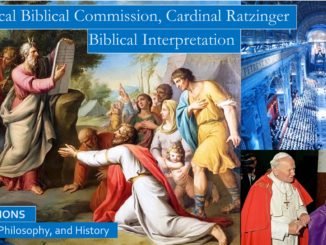
Biblical Interpretation in the Catholic Church, the 1994 Pontifical Biblical Commission Decree

Historically, the Catholic Church has defended itself from attacks, both real and imagined, from enemies of the faith, and this defensiveness also extended to Biblical studies. The twentieth century saw a relaxing of this defensiveness, culminating in the decree Dei Verbum pronounced by Vatican II, encouraging Catholic scholars to use more modern methods of interpreting the Scriptures, under the guidance of the Vatican office, the Pontifical Biblical Commission. […]