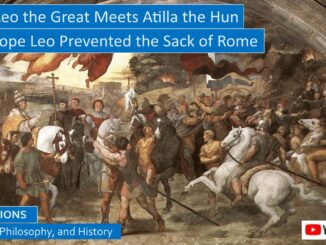
Pope Leo the Great, Confronting Attila the Hun, and His Role in Fourth Ecumenical Council of Chalcedon
Catholic Middle Ages and Beyond

Pope Leo the Great, Confronting Attila the Hun, and His Role in the Fourth Ecumenical Council of Chalcedon

As Pope Benedict XVI writes: “The times in which Pope Leo lived were very difficult: constant barbarian invasions, the gradual weakening of imperial authority in the West, and the long, drawn-out social crisis forced the Bishop of Rome” “to play an important role in both civil and political events.”
“In a period of profound crisis, Leo the Great knew how to make himself close to the people and the faithful with his pastoral action and his preaching. He enlivened charity in a Rome tried by famines, an influx of refugees, injustice, and poverty. He opposed pagan superstitions and actions of Manichaean groups. He associated the liturgy with the daily life of Christians.” […]
Did Rome Fall, or Evolve to Barbarian Kingdoms? Sack of Rome, and Attila the Hun’s Invasions
Greek and Roman History

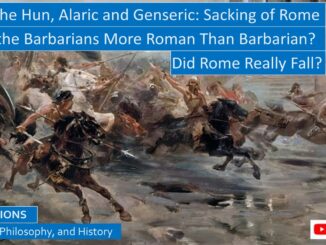
Did Rome Fall, or Evolve Into the Barbarian Kingdoms? Sacks of Rome, and Attila the Hun’s Invasions

Peter Brown contends: “The Roman Empire was not violently breached by barbarian “invasions.” Rather, between AD 200 and 400, the frontier itself changed. From being a defensive region, which kept Romans and barbarians apart, it had become, instead, an extensive middle ground, in which roman and barbarian societies were drawn together. And after AD 400, it was the barbarians and no longer the Romans who became the dominant partners in the middle ground.” Indeed, after AD 400 barbarian tribes served in the army of the Huns, and barbarians from most of the tribes, including the Huns, served in the Roman armies. […]

Ancient Warrior Culture, Slavery, Concubines, Ancient Greece, Rome, and Israel
History

Ancient Warrior Culture, Blog 1, War, Slaves, and Concubines in Ancient Greece, Rome, and Israel

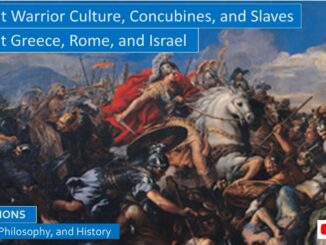
The Greeks were the most formidable fighting force in the Near East. The mighty Persian empire loaded their army on ships to fight what they thought would be an easy victory, but were decisively defeated by Athens and Sparta and their allies both on land and on sea in two separate wars. This established the reputation of the Greeks, later a Persian prince, Cyrus the Younger, hired a Greek hoplite infantry army to fight for the crown of Persia. The Greeks dominated the battle, but Cyrus was killed in the fighting. Losing their patron, the Greeks were forced to fight their way through the Persian Empire back to the Black Sea and then to Greece. This showed that the mighty Persians were vulnerable, later Alexander the Great of Macedon would conquer all of Persia and some of India also.

The Greeks may have been the founders of Western Civilization, but they were first and foremost a warrior society. If the Greeks weren’t formidable warriors they would have been conquered by the mighty Persian Empire, which means that there would be no Socrates, no Plato, no Xenophon, the Greeks would not have been able to leave us a cultural legacy. […]