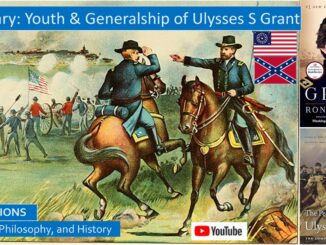
Summary of Youth and Military Career of Ulysses S Grant
Civil War Memories

Summary of Youth, West Point, and Generalship of Ulysses S Grant, From Mexican-American War to Civil War

Those who fought the Civil War grew up in the America of Andrew Jackson, when the giants of the second generation of American leaders fought to hold the United States together. These great orators, including Henry Clay and Daniel Webster, would later inspire Union soldiers to fight and die to preserve the Union. These were the years when the slave-owning Southern President Andrew Jackson threatened to deploy federal troops to prevent the secession of South Carolina over tariffs during the Nullification Crisis in the 1830s. […]
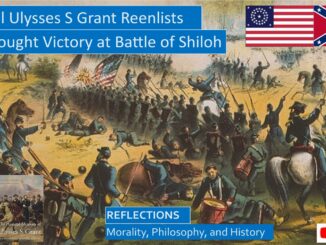
General Ulysses S Grant’s Victory at the Bloody Battle of Shiloh, and His Earlier Civil War Battles
Civil War Memories

General Ulysses S Grant’s Victory at the Bloody Battle of Shiloh, and His Earlier Civil War Battles

Chernow recounts: “Before Shiloh, Grant had nursed hopes for a titanic battle that would triumphantly crush the rebellion. Now, stunned by the combative spirit of his foes, he knew there would be many more bloodbaths in a long, grinding war of attrition. This began is conversion to a theory of total warfare in which all of southern society would have to be defeated.”
Chernow continues: “For Grant, Shiloh represented a personal victory. He had rescued his army from his own errors, showing a gumption and an audacity that altered the battle’s course. He had shown coolness under fire and a willingness to take monumental gambles. The battle also instilled lasting confidence in the Army of the Tennessee, shattering anew the fighting mystique of rebel soldiers.” […]

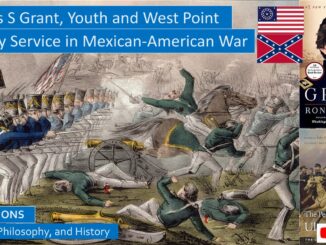
Early Life and Career of Ulysses S Grant Through His Service in the Mexican American War
Civil War Memories

Early Life and Career of Ulysses S Grant Through His Service in the Mexican American War

What was young Ulysses like? Chernow says that in his youth, Ulysses “seemed forgettable and colorless,” was not wayward or rambunctious or mischievous. “Like his mother, he was self-contained, as if he had trained his face to mask emotion and keep his inner life secret. Like Hannah, he was uncommonly even-tempered.” Unlike many great men of history, Ulysses in his youth had no vision of a great future and was prepared to live his life in obscurity. He was underestimated by many who met him.
Chernow describes traits that would serve him well later in life. “Never one to initiate a fight, he refused to back down when bullied. He was roused to fury if sadistic boys tormented an innocent child or a defenseless horse, and small boys embraced him as their steadfast protector.”
Ulysses was born with a love for horses. Chernow notes: “He liked to ride without a saddle or stirrups, sitting astride a blanket on the horse’s back, and he was so expert at handling horses that he began riding at age five. He became known for breaking in wild horses for local farmers.” “He tamed even the most refractory horses through a fine sensitivity to their nature rather than by his physical prowess.” […]

States' Rights v Federal Power From the Nation's Founding to Civil War, Jim Crow, and Civil Rights Movement
Civil Rights

States’ Rights v Federal Power From the Nation’s Founding to Civil War, Jim Crow, and Civil Rights Movement

The Constitution was drafted to correct the many weaknesses of the Articles of Confederation. Congressmen now swear allegiance to the United States rather than to their native states, as was done under the Articles. The Constitution grants the Federal government not only the power to levy taxes, but also to collect them, as well as sole control over trade and commerce. The Constitution establishes a Federal court system that can override state court decisions if there is a conflict. The US Congress, unlike the Confederation Congress, can pass routine legislation with a simple majority vote. […]

How Did the Speeches of Daniel Webster Inspire the North to Fight To Preserve the Union?
Civil War and Reconstruction

How Did the Speeches of Daniel Webster Inspire the North to Fight To Preserve the Union?

Webster knew that “the question of paramount importance in our affairs is likely to be, for some time to come, the Preservation of the Union, or its Dissolution; and now power can decide this question, but that of the People themselves.”
South Carolina not only set bad precedent, but she had also enacted a state law that stated that state militia could resist federal forces sent in to enforce the laws passed by Congress under the Constitution. Thus, you could argue that the Civil War did not start in 1864, that it really started in the 1830’s. […]

Civil War and Reconstruction

Why Were Union Soldiers in the Civil War Willing to Fight to Preserve the Union?

Professor Gallagher opens his book on the Union War, “The loyal American citizenry fought a war that also killed slavery. In a conflict that stretched across four years and claimed more than 800,000 US casualties, the nation experienced huge swings of civilian and military morale before crushing Confederate resistance. Union always remained the paramount goal, a fact clearly expressed by Abraham Lincoln in speeches and other statements designed to garner the widest popular support for the war effort.” […]