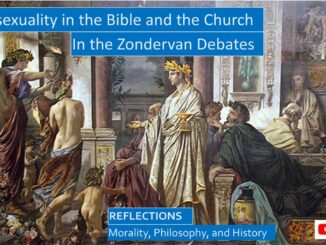
Homosexuality, the Bible, and the Church: The Zondervan Debates
christianity

Homosexuality, the Bible, and the Church: The Zondervan Debates

For better or worse, most of us choose our intimate partners, and build our world around that choice. If a homosexual couple is accepted by the clergy of your church, what good can come from telling them they are going to burn in hell if they do not repent? We are only responsible for our own personal salvation, it is not our job, particularly if we are laymen, to speculate on whether our neighbor will be saved. That is between them and Jesus, and nobody else.
My goal is not to change your mind about homosexuality. My goal is: If you do not accept that it is possible to be both a Christian and homosexual, that you will refrain from telling them they are damned to burn in hell, but would instead refer them to an Episcopalian Church, or other church where they would be welcome.
Jesus will judge us all in front of the great IMAX theater in the sky, where we will need to account for the decisions we made in our lives as they are displayed on that screen forty feet wide and forty feet tall. Jesus is the judge; we should not seek to do his job. Instead, we work out our own salvation, judging our own actions rather than our neighbors’. […]
Summary of St Augustine’s Confessions of Faith and Repentance
Morality

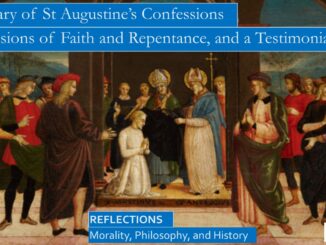
Summary of St Augustine’s Confessions of Faith and Repentance

The Confessions are both a testimonial and a prayer. St Augustine tells us how he embraced Christianity after he was active in the Manichean sect, a New Age dualistic system where good and evil competed more or less evenly, and where Jesus was totally divine without a trace of mortality. St Augustine had many of the same questions that we hear atheists and agnostics raise today, such as: How can intelligent and sophisticated men believe in superstitions about an Almighty God? How can God be Almighty when sin has such a hold in the world? What is the nature of evil? […]

St Augustine’s Confessions, His Conversion, Baptism, St Monica’s Death, and Philosophy, Books 8 & 9
Morality

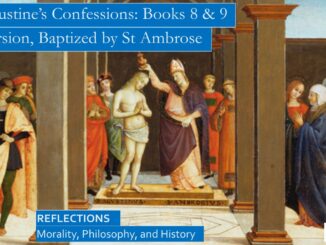
St Augustine’s Confessions, His Conversion, Baptism, St Monica’s Death, and Philosophy, Books 8 & 9

Baptism and confession in ancient Rome were very viewed much more seriously in the ancient world than they are today, as the Christian persecutions were in living memory. St Augustine was baptized in the year 387 while the former Emperor Constantine the Great started favoring Christianity in the year 312, putting to an end the vicious persecution of Christians under the preceding Emperor Diocletian, which was only seventy-five years ago.

Although the severe Diocletian persecutions were fading into history, many Christians had parents or grandparents who suffered and martyred for their Christian faith. There was a strong feeling among the Christians that they needed to be serious about baptism, that committing mortal sins after baptism could endanger their immortal soul. Constantine was baptized on his deathbed since he feared damnation for those enemies that were killed on the battlefield. Monica had delayed her son’s baptism because she was not sure he could repent of the inevitable sins teenagers with raging hormones would commit, and he declined to be baptized until he left the Manichean heresy in his middle age. Many Christians in the time of St Augustine desired to be as serious about their faith as the martyrs were about the faith that they sacrificed their life for.

This explains Augustine’s anxieties as he prepares himself for the challenge of living as perfect a Christian life as possible after his baptism. His anxiety was that he could not control his passions, a common concern in a Roman world so deeply influenced by Stoic philosophy. St Augustine tells us several conversion stories that were shared with him before his own conversion story. […]

Morality

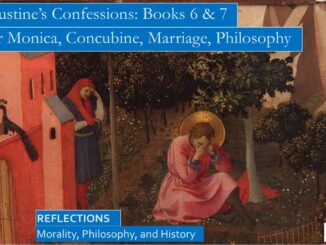
St Augustine’s Confessions: Mother Monica, Concubine, Marriage, and Philosophy, Books 6 & 7

The Confessions were written soon after St Augustine was drafted to be the co-bishop of Hippo, near Carthage. The Confessions are not only a confession of faith and a confession of sin and sinful longings, but also a mirror into his soul, exploring his innermost motivations. The style is unique, Bishop Augustine addresses his Confessions as a prayer to God, addressing God directly, imbedding verses of Scripture and the Psalms directly into his Confessions as he writes these words on his soul. […]